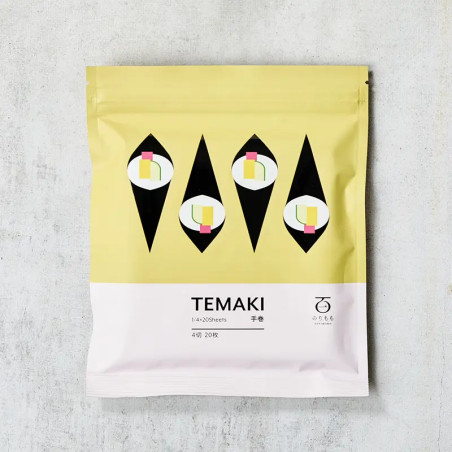
In Japanese, the term "maki" refers to any type of sushi roller containing Nori algae, and "you" means "hand".
Thus, the Temaki is defined as a variety of sushi characterized by being rolled by hand, cone-shaped. In Japan, it's called Makizushi or Maki Sushi.
There are several types of sushi rollers:
Hosomaki : Fine rollers, about 2.5 cm in diameter, with a leaf of Nori outside, containing a single ingredient (eg lawyer & cucumber & salmon)
Chumaki : Medium rollers, about 2.5 to 3.8 cm in diameter, wrapped in Nori outside, containing 2 to 3 ingredients (eg salmon, lawyer, cucumber)
Futomaki : Thick rollers, with a diameter of about 5 to 6.3 cm, with from Nori outside, containing 4 to 5 ingredients (for example, salmon, lawyer, cucumber, philadelphia cheese)
Uramaki : "Upside down" rollers with Nori inside, more known as California Roll
Temaki : Cone-shaped sushi rollers, garnished with rice and several ingredients
Hosomaki therefore means "Fine Roll" in Japanese. It has a slender shape and a simple style and is presented on a small bamboo mat. The Hosomaki is composed of sushi rice wrapped in a leaf of Nori (dried algae) with a garnish, which can be vegetables or fish. To make it a quick snack or an ideal entrance, it must be cut into small pieces.
The Hosomaki is prepared with a bamboo mat. The main difference between the maki and the Temaki lies in their form.
The maki is rolled tube shaped with a bamboo sushi mat, and the ingredients are wrapped in a large leaf of Nori. The Temaki is rolled by hand-shaped hand with a small leaf of Nori.
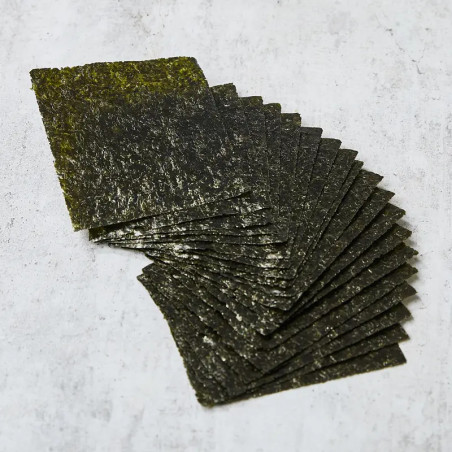
The Nori algae proposed here has been toasted. It restores a crispy, crispy, marine and delicately iodized texture to subtle and elegant umami. This algae, rich in minerals, also acts as exhaustor of taste. These Nori Temaki are entirely natural, without additives or preservatives.