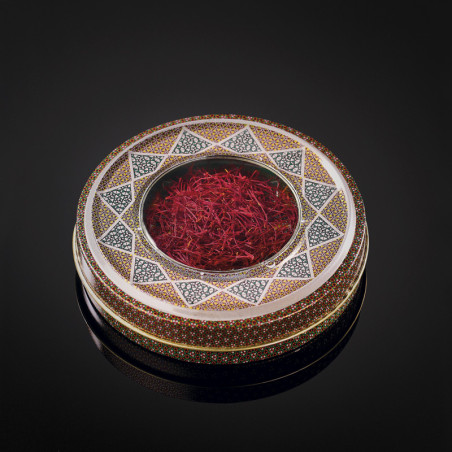
Targh NEGUINE SAFRAN pearl
100% Safran (Crocus Sativus L. Filaments)
Saffron is part of the spice family. It is used in cooking as well for its aroma and for the golden yellow color that gives dishes. These aromatic and coloring characteristics make it a very popular condiment around the world, and especially in Iranian cuisine, wrongly confused in the term "oriental cuisine".
The saffron accompanies fish. It is distinguished in a paella, a bouillabaisse, a tajine or a risotto. Spanish, Moroccan or Italian cuisines are coming up with warm notes of this colorful spice.
Its use as a medicinal plant is the subject of many conclusive studies. It is ready for its active agents - including saffronal and crocin - a strong antioxidant, but also anticancer, antimutaggene and immuno-regulatory power.
Saffron culture
Saffron is cultivated in several countries of the world, including France. But it is in Iran that the culture of "red gold" started, there are a few thousand years ago. Delicate, the saffron culture requires a meticulous know-how. The picking is careful, concentrated over a particularly short time (the Crocus blooms only about twenty days per year). The flower is not preserved for a long time (48 hours at most). The saffron flower, whose conservation does not exceed 48 hours, has 6 purple petals, three gold yellow color stamens and a red pistil. It is this famous pistil composed of three stigmata (Filaments) which, once dried, gives saffron as used in spice.
The pistils of the Crocus Sativus are collected one by one then they are "imposed", separated and sorted with an extreme address. A labor exclusively dedicated to Iranian women: they spread the petals of the pistil, extract the stem and the stamens and then preciously reserve the upper red part: the stigma.
A goldsmith job that contributes to the cost of this exceptional product.
Negulaine: the pearl of saffron
Neguine means "Saffron's bead" in Persian. It is an exceptional product, the rarest and famous quality. The true Negosian Saffron consists of the only superior part of the crocus stigma. A piece with extraordinary aromatic power, with deep red color characteristic and whose work is done by golden hands.
The villages of Targh and Natanz are recognized as the cradle of saffron production in Iran.
The pepper counter went to meet the producers of these two villages to bring you the best.
The true negosician saffron consists of the only upper part of the crocus stigma.
Neither white part nor yellow party for this part to extraordinary aromatic power, deep red color so characteristic and whose work is done by golden hands.
Indeed, at the Zabeti domain, the best flowers are selected for the exceptional quality of their thick and long stigma. Their cut is carried out by women who have the particularity is to be old bakers or pastries.
In Iran, bakers and pastries are sensitive to the quality of the flour they consider to the touch.
The pulp of their fingers, by year of year to judge the quality of the flour, has become ultra-sensitive and can judge the softness and texture of the stigma. These are chosen one by one and only the red part is preserved.
It takes 70 to 80 extremities of pistils to obtain 1 g of Negulaine Saffron.
The stigmas are then dried over ceramic trays for about 72 hours, in total darkness, and at room temperature. After drying and a loss of about 80% of its original weight, saffron is refined in airtight glass pots so that this red gold is freezing at the best of its abilities.
The rest of the stigma is used for the production of spice mix.
Every year, the Targh cooperative organizes the Saffron coloring test. Each producer deposits a gram of saffron in his own tank of milk. The quality of the saffron of each is defined according to the coloring and the aromatization of the liquid which is then used for the manufacture of ice "Bastanie". Depending on the test, a gram of Safran from the Zabeti domain colors and aromatize 500 to 600 liters of milk.
Our perfect agreements : The saffron negresses the pepper counter is in the form of filaments in a pretty hermetic bitch at the Persian theme. Provide 1 to 2 pistils per person, ie 3 to 6 filaments (1 pistil weighing about 0.01 g).
In the case of a saffron presented in filaments such as ours; You will have to let infuse in a little lukewarm liquid (water, broth, sauce of your preparation).
Wait 5 to 10 minutes so that the infusion becomes well yellow, then incorporate it into the preparation at the beginning of cooking.
Saffron is used in Arab, European, Indian, Iranian or Central Asian cuisines.
In particular, it is used such a condiment for rice in India, Spain, Iran and many countries.
The lovers of Saffron love his touch of honey mixed with his metal notes. Used in very small quantities, saffron contributes to the yellow-orange color of the dishes it perfumes. All these features make saffron a popular spice for dishes, sauces, jelly and jams.
A jelly or a saffron-based jam can reveal a cheese.
The saffron sublimates a curry, perfumes a liquor, aromatizes a soup. He will make an exceptional fish.
Saffron is used to wonderfully in the most simple cakes and four-quarters.
A single rule : Never grab the saffron in oil or butter, but incorporate it into a liquid.