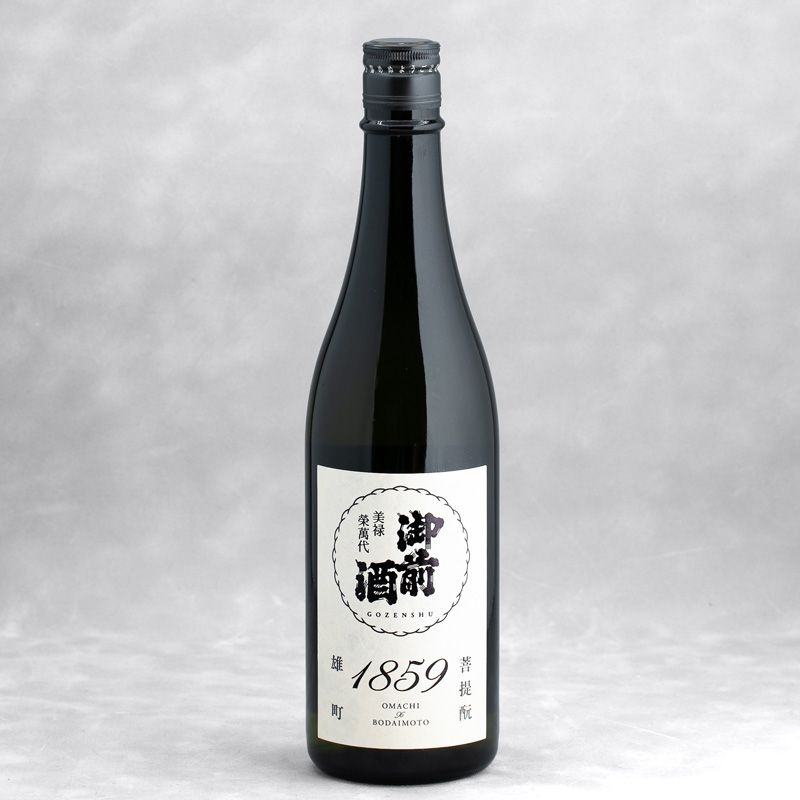
Tsuji Honten's master craftsmen began to wonder what "unshakeable nobility and beauty" they must continue to continue to be stressed where they are, while thinking about the inheritance to leave for future generations.
To perfect their craftsmanship and purify all aspects, the answer becomes obvious: favor the variety of omachi rice while converting all of their manufacture of saké to Bodaimoto brewing.
Bodaimoto brewing, for Gozenshu (sake of the lords), is a medieval tank feet manufacturing technique (Shubo, motorcycle) 1,000 years ago to mix malty in a large amount of water Pure.
For our Gozenshu 1859, malted rice is placed in a laundry and then tempered in a pure water tank for 10 to 25 days and, under the action of natural lactic and yeast natural bacteria naturally in the environment is lacked. The acidity of the water (pH) can then rise up to 6.5. This acidic water is called "soyashi" or "soyashimizu" water. It allows the creation of the tank foot or mother of Sake. It promotes the development of good yeasts and prevents the formation or appearance of bad bacteria. The addition of steamed cooked rice and Kôji will allow the creation of the Shubo (tank foot, mother of Sake). The kobo (yeast) is then added and will give birth 10 to 14 days later, to the Moromi.
From this Moromi will be extracted the saké. "1859" corresponds to the birth of OMACHI rice.
It was at that time that a Farmer of Bizen (Okayama Prefecture), Jinzo Kishimoto, discovers and operates two rice plants, known nowadays under the name Omachi, whose quality is nationally renowned in Japan.
The Municipalities of Setocho and Akasaka in the former County Akaiwa, located southeast of Okayama, are known to produce the best OMACHI rice.
Over the last 25 years, Tsuji Honten has partnered with Setocho OMACHI Bukai (Setocho farmers' study group on specialty omachi rice) for the supply of her rice.
In 2019, the year of the 160th anniversary of the discovery of the Omachi rice variety, it jointly launched a new project entitled "Tokujo Omachi project" to create the specialized omachi rice.
In the early 1980s, Tsuji Honten is the rebirth spearhead of the Bodaimoto method, lost at the beginning of the Showa period (1926-1989). Although about 40% of their saké was brewed with this method, they are convinced that this old brewing technique has endless possibilities.
By entering the heart of their brewing philosophy and returning to a classic method as such, Tsuji Honten is about to take the world by surprise by showing a deeper and more interesting world of Sake.
To launch the "100% Bodaimoto" plan, Gozenshu are born.
This dry saké, transparent with light silver reflections, is remarkable.
The aromas evoke the result of the dragon, the cranberry and the green apple.
The mouth, complex, first offers a beautiful acidity, almost peach, with grapefruit zest notes, lemon. Then the flavors evolve, rounded, fresh nuts and other nuts, mushrooms, pear, banana.
.png) Tasting side, we recommend agreements with dried fruits, parsley cheeses, lawyer, fresh goat cheeses, tuna sashimi, grilled fat fish, oysters, caviar, pork ham Iberian.
Tasting side, we recommend agreements with dried fruits, parsley cheeses, lawyer, fresh goat cheeses, tuna sashimi, grilled fat fish, oysters, caviar, pork ham Iberian.