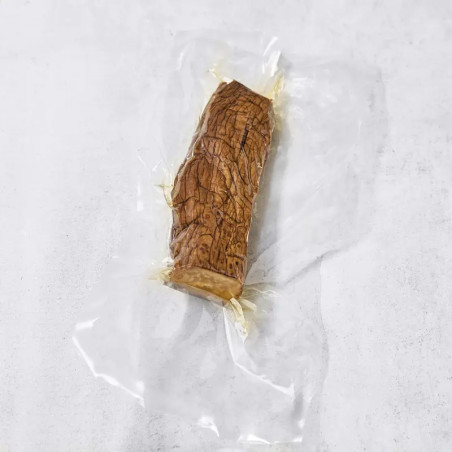
Japanese smoked radish is a traditional dish prepared since the Muromachi period (1336-1573) in the Akita region of northern Japan. Known locally as Iburigakko, it is made by first smoking Japanese white radishes (daikon) before fermenting.
Production begins in early winter. However, Akita, a prefecture where it is traditionally produced, is one of Japan's most snow-covered regions, making it difficult to dry out agricultural products. In the past, households were suspending radishes above the "irori", a traditional indoor fireplace, where they were slightly smoked by the rising smoke of firewood. This method dehydrates the radish while giving it a characteristic aroma.
Nowadays, the manufacturing process always begins in winter, in December, at the end of the agricultural season, by smoking radishes for three days, using cherry and oak wood.
The radishes are placed in suspension above the fire, recreating the Muromachi tradition of smoking them over the irori (home fireplace present in Japanese houses of type minka).
The radishes of pure white then gradually take a deep smoke tint.
After three days, the doors of the smoking room open.
The radishes, slightly dried by smoke, are golden and firm.
Their aroma is rich and mellow, imbued with a smell of smoke.
After smoking, they are rinsed once in the water.
Then comes the second stage: the marinade.
The radishes are dipped in layers in a fermentation bed composed of rice and other traditional ingredients, salt, sugar and vinegar, where they undergo a slow lactic fermentation.
Hermetically closed, the bins promote the fermentation of vegetable lactic bacteria.
The fermentation of Japanese smoked radish has similarities with malolactic fermentation used in vinification processes, with low temperature fermentation lasting about two months.
In February, the marinade is finished and the iburigakko is ready, reduced to about a quarter of its initial weight, giving it its characteristic crunch.
The first step in the iburigakko manufacturing process is to cut each piece in half.
The iburigakko can then be kept as it is or be sliced or cut into small pieces.
An original preservative fluid is then added and the product is vacuum-packed and then autoclaved to ensure long-term storage.
Originally, iburigakko was valued as a winter food, offering both flavour and nutrients during the rigorous season.
In recent years, iburigakko has experienced a renewed popularity. It is now widely appreciated in accompaniment to cheese and also arouses interest as a tasty ingredient in sushi and onigiri. Today, it is offered in a wide variety of products by the main Japanese chain stores.