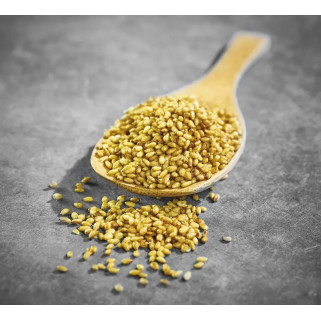
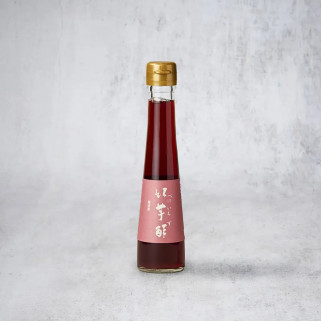
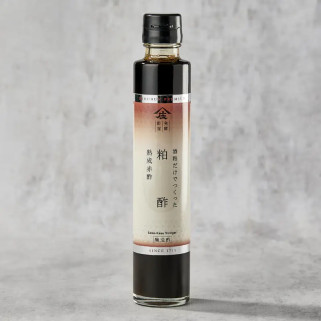
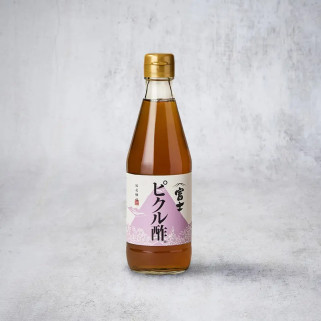
In 1624, at the beginning of Edo, Seiemon, the first member of the Takahashi family, settled in Okawa / Enozu, Port city of Kurume Domaine, in the province of Chikugo. Shiroblei, second generation, founded a Sake brewery. Benefiting from the waters of the Chikugo River and fertile soil, the province of Chikugo is a rice region, cradle of a high quality saké. The vinegar comes from the fermentation of the saké. Following this tradition, Seimon, fourth generation, launched in the production of vinegar. Thus born Shobun Vinegar, a vineurie that has been paying over 300 years. During this period, the times changed quickly and the lives of people enjoyed deep transformations. The vinegar production methods seem to have been dominated by large companies, which focuses on the fermentation and fast aging as well as mass production. However, at Shobunsu, vinegar masters are convinced that the true value lies in the artisanal and rigorous production of vinegar in Okawa / Enozu. For many years, they have consistently produce a high quality vinegar, without ever disappointing their customers. Make good vinegar is like raising a child: you have to watch it closely and do not neglect the details. The fermentation process of organic brown rice black vinegar is improved. Thanks to the riches of the Earth, Shobunsu develops a black brown rice vinegar according to traditional methods. Their organic brown rice black vinegar consists of three ingredients: rice, water and koji. The process is simple, and it is precisely this simplicity that allows the quality of the ingredients to reflect in the flavor of vinegar. Their black brown brown rice vinegar is made from organic brown rice from farmers from Kumamoto Prefecture and elsewhere. Brown rice itself must be free of chemical fertilizers and pesticides, and the surrounding environment and water must also be exempt from any contamination. The natural flavor of brown rice must be preserved. Thanks to their direct relationship with our producers, they sometimes visit their farms to observe their farming methods closely. Biological brown rice black vinegar is brewed twice a year, around spring and autumn equinoxes. The biological brown rice is steamed, then the Koji rice is added and mixed. Koji rice and steam cooked rice are mixed in a jar filled with fermentation water, and Koji is sprinkled on the surface. The fermentation jar, half buried, is a great jar used from antiquity. This ceramic jar absorbs heat from the sun and promotes fermentation. Its paper lid is made of Japanese paper coated with khaki tannins and funitorial seaweed. The fermentation date is entered in the live ink. The fermentation takes place peacefully in the fermentation jar. The Koji, a high quality mold, transforms the sugar rice, which is then metabolized by the action of yeasts, and then, thanks to the acetic bacteria present on the surface, in vinegar. This mysterious process of vinegar production by microorganisms is not only based on bacteria. The static fermentation in jar requires human intervention, called "maintenance". For the three months that fermentation lasts, the paper cover is open from time to time to check and preserve the condition of the biofilm. The condition of this biofilm varies from one jar to another, giving it a unique character. "It's like raising a child," says a vinegar craftsman. After three months of static fermentation, the young vinegar is finally ready for aging in tank. The brewed vinegar around the autumn equinox begins aging with the arrival of the winter cold, while the one brewed around the spring equinox begins before the strong heat weather. The saying "The heat and the cold will last until the equinox" is still relevant in the world of the production of black brown brown rice black vinegar. The secret of the delicious shook flavor Shobunsu produces vinegar, including pure rice vinegar and fermented vinegar, throughout the year. The production method, however, remains meticulous, demanding a consequent fermentation and maturation time. Essential bacteria are preserved with the same care as for brown rice black vinegar. Fermentation takes place in a warehouse built more than 80 years ago, in wooden drums and fermentation tanks with a koku capacity, where vinegar is slowly resting. The fermentation of the vinegar corroding the metal, its use is reduced to a minimum in the construction of the drums and the warehouse. In addition, the latter is very well ventilated, now a stable temperature in all seasons, fresh in summer and warm in winter. Vinigragriers nevertheless ensure the microbial activity of bacteria. By light cold, they envelop the drums of straw wood like a futon, and by strong heat, they open the doors of the warehouse. They are constantly attentive to "vinegar growth". There is another reason to ferment vinegar in an old brewery: Never rush things, never be carried away by the short-term imperatives. Inside the brewery, over time, specific bacteria develop. These bacteria are still present in the old breweries of the brasseries of Sake and traditional vineuries, and are in a way the "bacterial mother" of these institutions. They feed the vinegar, giving it its sweet flavor. After brewery fermentation and tank storage, vinegar takes a pale amber color, with subtle acidity and aroma. Our craftsmen check taste, color and aroma, and under rigorous quality control, it undergoes a last filtration and sterilization before being marketed. Compared to fast fermentation, this method is much longer and demanding. Yet she has remained unchanged for 300 years. Of course, modern technologies have been integrated for temperature control, etc. But the method of manufacturing base vinegar remains ancestral. Shobunsu's vinegar craftsmen absolutely do not think that rushing to produce in large quantities is the right solution. On the contrary, Shobun Vinegar is proud to adopt a diametrically opposite approach. 1. Commitment to fermentation among many vinegars obtained over more than 300 years of production, Shobunsu carefully selects fermented vinegars strictly to create drinking vinegars, seasoning vinegars and products transformed. 2. Commitment to the Shobun Ingredients grants great importance to human relations, and the premium product range uses national or cultivated ingredients in Kyushu and is manufactured without additives. 3. Commitment to the taste and method of manufacture The table vinegar is without sugar and only sweet to honey. Each product is carefully elaborated, from the development of the flavor to production.