


















Udon Kitahonami long extra thick 250g
Taxes included at checkout
Shipping
⚠️ Delivery outside mainland France or outside the EU
For deliveries outside mainland France or the European Union (French overseas departments and territories, Canary Islands, United Kingdom, Switzerland, Norway, and other non-EU territories), customs duties, local taxes (dock dues, IGIC, AIEM, etc.) or customs clearance fees may be charged upon delivery, in addition to the price paid on the website.
- Checking your delivery
You must inspect the delivery upon receiving your parcel, meaning opening the parcel(s) in the presence of the courier and checking the contents. Do not sign any delivery note before checking your parcel(s). Any anomaly must be detailed on the delivery note or, in the case of an electronic terminal, on a form that the courier must provide to you upon simple request. Specify the exact number of missing items, the name of the missing product(s), the number of broken, damaged or soiled products and their names, (Photographs of the packaging showing the shipping label, as well as the broken or damaged products, must be provided). If you are unable to open the parcel in front of the courier, record a reservation by default. In case of non-compliance with these instructions, no claim will be accepted by the carrier and will not give rise to a refund for the products concerned, and Nishikidôri cannot be held responsible. You must keep a copy of the delivery note or form to send to us by email at sav@nishikidori.com in order to process your request immediately. In the event of breakage inside the parcel and provided a proper reservation was recorded with the courier, Nishikidôri will cover the reshipping costs for the replacement product(s).
2. FREE Click & Collect at the Nishikidôri Ancenis warehouse
Shop online or by phone and collect your order via Click & Collect at your Nishikidôri Ancenis (44) collection point 140 rue Georges Guynemer ZAC de l'Aéropôle 44150 Ancenis - France
Collect your order from the day after your purchase for any order confirmed by 16:00. (from the following Tuesday for orders placed on Saturday or Sunday)
Collection times:
Monday to Friday from 9:00 am to 12:30 pm and from 2:00 pm to 5:30 pm. Your order is available at the collection point for 5 working days. Please indicate your preferred collection date in the order comments.
3. FREE Click & Collect at your Paris Boutique
Boutique delivery is dispatched from our warehouse in Ancenis on Monday afternoons and Thursday afternoons. We commit to delivering to the boutique within 2 to 4 working days following your order date. For example, if you place an order between Thursday afternoon and Monday morning, your product will be available by Tuesday midday in the boutique. Likewise, if your order is placed between Monday afternoon and Thursday morning, you will be able to collect it from Friday.
Once your order is ready in the boutique, you will have 10 days to collect it. This service is available to both professionals and individuals. When you visit the boutique to pick up your order, you must present proof of identity. To ensure everything is in order, we will ask you to check the entirety of your parcel in the presence of our sales assistant, ensuring in particular that there is no breakage and that all products are present.
Opening hours:
- Monday to Saturday from 11:00 to 19:00
- Nishikidori Paris Boutique: 6 rue Villedo 75001 Paris

4. Colissimo Collection Point
From 2 to 5 working days (for mainland France and Corsica), the average delivery time for Colissimo Standard is 48h. (Please allow an additional 24h for order preparation).
Free delivery thresholds for individuals:
- From 80€ purchase incl. VAT for Mainland France and Corsica: FREE delivery.
- From €120 incl. VAT for the EU zone : FREE delivery.
Shipping costs valid for a weight less than or equal to 20kg. For heavier parcels, please contact our customer service on +33 (0)2 40 83 33 99 or by email: contact@nishikidori.com
Shipment tracking:
A tracking number will be sent to you. You will also be able to check the estimated delivery time, view the driver's real-time position, and have the option to change the delivery time directly from your mobile phone.
If your parcel is not collected from the collection point, it will be returned to us. You will have the option to request it to be resent, subject to payment of shipping fees. If we receive no reply from you or following a refusal of reshipment within 3 days, the contents of your parcel will automatically be returned to stock and we will proceed with refunding the items (excluding delivery charges)
5. Colissimo Home Delivery
From 2 to 5 working days (for mainland France and Corsica), the average delivery time for Colissimo Standard is 48h. (Please allow an additional 24h for order preparation).
Free delivery thresholds for individuals:
- From 100€ purchase incl. VAT for Mainland France and Corsica: FREE delivery.
- From €140incl. VAT for the EU zone : FREE delivery.
Shipping costs valid for a weight less than or equal to 20kg. For heavier parcels, please contact our customer service on +33 (0)2 40 83 33 99 or by email: contact@nishikidori.com
Shipment tracking:
A tracking number will be sent to you. You will also be able to check the estimated delivery time, view the driver's real-time position, and have the option to change the delivery time directly from your mobile phone.
If your parcel is not collected from the collection point, it will be returned to us. You will have the option to request it to be resent, subject to payment of shipping fees. If we receive no reply from you or following a refusal of reshipment within 3 days, the contents of your parcel will automatically be returned to stock and we will proceed with refunding the items (excluding delivery charges)

6. Chronopost express mainland France and Corsica
Delivery for individuals before 6:00 pm next working day (for mainland France and Corsica).
Free delivery thresholds for individuals:
- From 100€ purchase incl. VAT for Mainland France and Corsica: FREE delivery.
- From €140incl. VAT for the EU zone : FREE delivery.
Shipping costs valid for a weight less than or equal to 20kg. For heavier parcels, please contact our customer service on +33 (0)2 40 83 33 99 or by email: contact@nishikidori.com
7. Chronopost classic Europe
2 to 6 working days (for Europe).Delivery times are provided for information purposes only and in working days, from mainland France. Please allow an additional 24 hours for the preparation of your order).
Free delivery thresholds for individuals:
- From 100€ purchase incl. VAT for Mainland France and Corsica: FREE delivery.
- From €140incl. VAT for the EU zone : FREE delivery.
Shipping costs valid for a weight less than or equal to 20kg. For heavier parcels, please contact our customer service on +33 (0)2 40 83 33 99 or by email: contact@nishikidori.com
8. Chronopost Express World
1 to 3 working days in major global economic centres and 2 to 5 days in the rest of the world. Delivery times are provided for information purposes only and in working days, from mainland France. Please allow an additional 24 hours for the preparation of your order).
Free delivery thresholds for individuals:
- From 100€ purchase incl. VAT for Mainland France and Corsica: FREE delivery.
- From €140incl. VAT for the EU zone : FREE delivery.
Shipping costs valid for a weight less than or equal to 20kg. For heavier parcels, please contact our customer service on +33 (0)2 40 83 33 99 or by email: contact@nishikidori.com
9. Special conditions
Delivery of alcohol is prohibited to Norway.
Delivery of alcohol is not available via Colissimo for the United Kingdom and Switzerland.
10. Product return conditions
SASU PALMIFRANCE accepts the return of any item purchased on the site, provided it is returned within FOURTEEN (14) days from the delivery date, with the exception of products likely to deteriorate or expire rapidly and products whose packaging or freshness pouch has been opened.
Click HERE to access the Return Slip template. No returns will be accepted after this period has expired.
SASU PALMIFRANCE has set up a link to facilitate your delivery and potential return processes. Return shipping costs will remain the responsibility of the Buyer, including in the event of definitive refusal of the returned products. If the Buyer exercises their right of withdrawal provided for in Article L. 221-18 of the French Consumer Code (see Article 8 below), they will be entitled to a refund of initial delivery costs. The Buyer must then specify whether they request an exchange or a refund of the products. If the replacement product has a higher value than the product originally ordered, the Buyer will be invited to pay the difference using any payment method made available to them. If the replacement product has a lower commercial value than the product originally ordered, the Seller will refund the difference.
To return an item, the Buyer must strictly follow these instructions
- Use the original packaging to return the product
- Complete and include the Return Form inside the parcel. Returns without a Return Form will not be accepted.
- Send the parcel to the following address: Société SASU PALMIFRANCE For the attention of the Returns Department Z.A.C Aéropôle, 140, Rue Georges Guynemer, BP 40261 44158 ANCENIS.
Products must strictly be returned to SASU PALMIFRANCE in their original condition (packaging, accessories, instructions, etc.), duly sealed, and accompanied by the signed Return Form. SASU PALMIFRANCE does not accept parcels sent postage due. All risks associated with returning the product are borne by the Buyer. Failure to comply with the procedure set out above and the stated deadlines means the Buyer cannot make any claim for non-conformity or apparent defect of the delivered products, which will then be deemed compliant and free of any apparent defect. Non-compliance of the ordered products with one or more specific standards applicable in the country of a Buyer residing outside France shall in no case constitute grounds for returning products or refunding the order.
11. Right of withdrawal
Pursuant to Article L.221-18 of the French Consumer Code, the Buyer has a period of fourteen (14) days to exercise their right of withdrawal from a distance contract, following telephone canvassing or off-premises selling, without having to give reasons for their decision or incur costs other than those provided for in Articles L. 221-23 to L. 221-25.
The period mentioned in the first paragraph runs from the day following:
- either the conclusion of the contract, for service contracts and those mentioned in Article L. 221-4,
- or the receipt of the goods by the consumer or a third party, other than the carrier, designated by them, for contracts for the sale of goods.
For contracts concluded off-premises, the consumer may exercise their right of withdrawal from the conclusion of the contract.
In the case of an order covering several goods delivered separately or in the case of an order for a good made up of lots or multiple pieces whose delivery is staggered over a defined period, the period runs from receipt of the last good or lot or the last piece.
When the FOURTEEN (14) day period expires on a Sunday, or a public holiday or non-working day, it is extended until the next working day.
The right of withdrawal may be exercised by the Buyer, only if they hold the status of Consumer, without having to give reasons or pay penalties, with the exception of return shipping costs which are not reimbursed.
The Withdrawal Form can be downloaded by clicking HERE.
Products must imperatively be returned to SASU PALMIFRANCE in perfect resale condition, in their original condition (packaging, accessories, instructions, etc.), properly sealed, and accompanied by the signed return slip in accordance with the procedure described in the article above. In accordance with the provisions of Article L.221-23 of the French Consumer Code, the Buyer is liable for any depreciation of the Products resulting from handling other than that necessary to establish the nature, characteristics, and proper functioning.
Excluded from the right of withdrawal are sales of products referred to in Article L221-28 of the French Consumer Code, and notably contracts for:
"- 4° The supply of goods likely to deteriorate or expire rapidly;
- 5° The supply of goods that have been unsealed by the consumer after delivery and cannot be returned for reasons of hygiene or health protection;
- […]
- 7° The supply of alcoholic beverages whose delivery is deferred beyond thirty days and whose value agreed upon conclusion of the contract depends on fluctuations in the market beyond the professional's control; »
For the purposes of these terms, products whose minimum durability date expires within thirty (30) days—a timeframe incompatible with exercising the right of return and resale by the Seller—are considered to deteriorate or expire rapidly. In the event that the Buyer exercises a right of withdrawal, the Seller shall refund all sums paid, including delivery costs, as provided for by Article L.221-24 of the French Consumer Code, once the returned products have been received or the Buyer has provided proof of dispatch.
- Impressive elasticity
- Soft and fluffy
- Timeless tasting
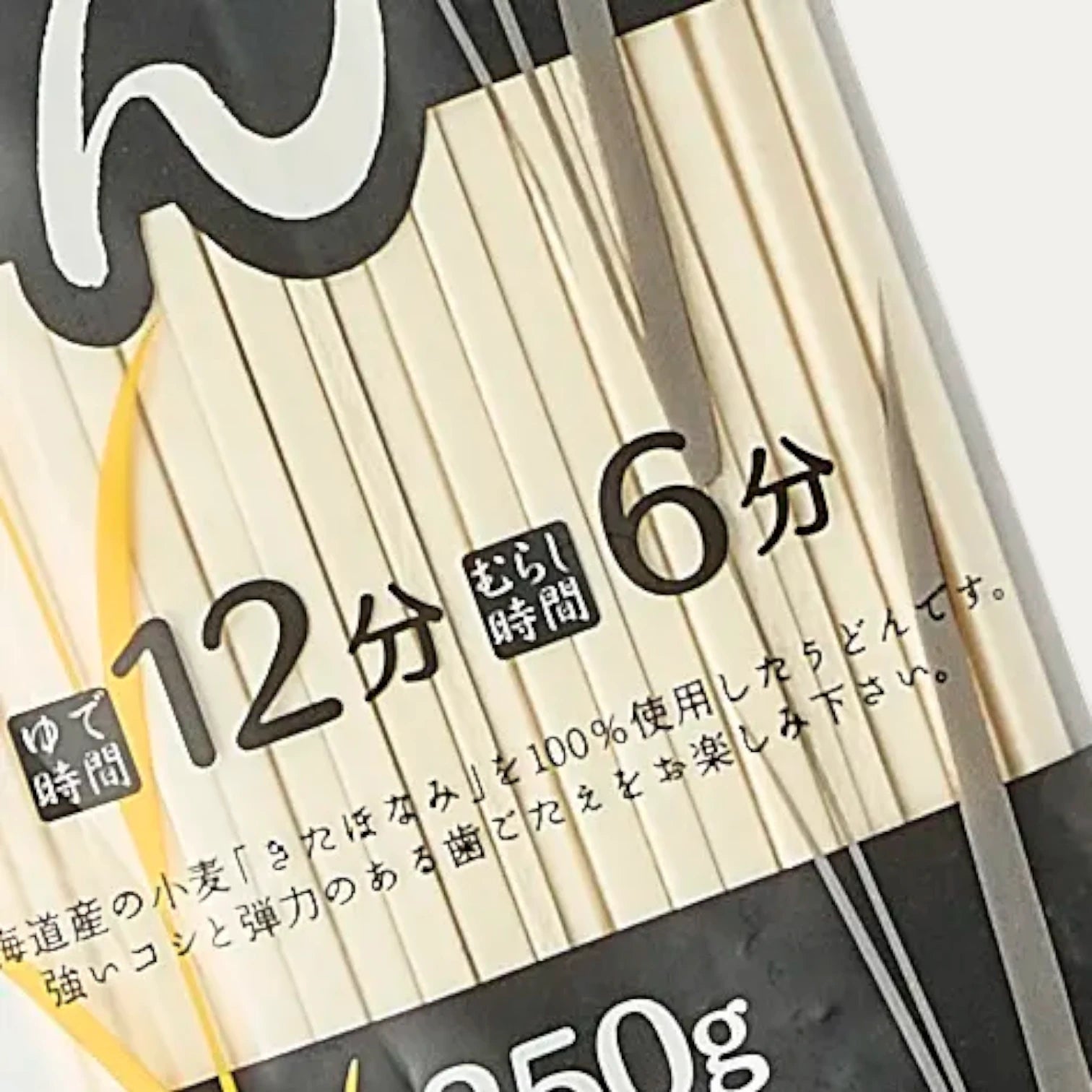
These udon noodles are made from 100% "Kitahonami" wheat from Hokkaido. As the name suggests, "extra thick", these udon have a firmness, elasticity and chewiness you have never experienced before with ordinary udon!
Udon Kitahonami long extra thick 250g
View detailsTaxes included at checkout
Shipping
⚠️ Delivery outside mainland France or outside the EU
For deliveries outside mainland France or the European Union (French overseas departments and territories, Canary Islands, United Kingdom, Switzerland, Norway, and other non-EU territories), customs duties, local taxes (dock dues, IGIC, AIEM, etc.) or customs clearance fees may be charged upon delivery, in addition to the price paid on the website.
- Checking your delivery
You must inspect the delivery upon receiving your parcel, meaning opening the parcel(s) in the presence of the courier and checking the contents. Do not sign any delivery note before checking your parcel(s). Any anomaly must be detailed on the delivery note or, in the case of an electronic terminal, on a form that the courier must provide to you upon simple request. Specify the exact number of missing items, the name of the missing product(s), the number of broken, damaged or soiled products and their names, (Photographs of the packaging showing the shipping label, as well as the broken or damaged products, must be provided). If you are unable to open the parcel in front of the courier, record a reservation by default. In case of non-compliance with these instructions, no claim will be accepted by the carrier and will not give rise to a refund for the products concerned, and Nishikidôri cannot be held responsible. You must keep a copy of the delivery note or form to send to us by email at sav@nishikidori.com in order to process your request immediately. In the event of breakage inside the parcel and provided a proper reservation was recorded with the courier, Nishikidôri will cover the reshipping costs for the replacement product(s).
2. FREE Click & Collect at the Nishikidôri Ancenis warehouse
Shop online or by phone and collect your order via Click & Collect at your Nishikidôri Ancenis (44) collection point 140 rue Georges Guynemer ZAC de l'Aéropôle 44150 Ancenis - France
Collect your order from the day after your purchase for any order confirmed by 16:00. (from the following Tuesday for orders placed on Saturday or Sunday)
Collection times:
Monday to Friday from 9:00 am to 12:30 pm and from 2:00 pm to 5:30 pm. Your order is available at the collection point for 5 working days. Please indicate your preferred collection date in the order comments.
3. FREE Click & Collect at your Paris Boutique
Boutique delivery is dispatched from our warehouse in Ancenis on Monday afternoons and Thursday afternoons. We commit to delivering to the boutique within 2 to 4 working days following your order date. For example, if you place an order between Thursday afternoon and Monday morning, your product will be available by Tuesday midday in the boutique. Likewise, if your order is placed between Monday afternoon and Thursday morning, you will be able to collect it from Friday.
Once your order is ready in the boutique, you will have 10 days to collect it. This service is available to both professionals and individuals. When you visit the boutique to pick up your order, you must present proof of identity. To ensure everything is in order, we will ask you to check the entirety of your parcel in the presence of our sales assistant, ensuring in particular that there is no breakage and that all products are present.
Opening hours:
- Monday to Saturday from 11:00 to 19:00
- Nishikidori Paris Boutique: 6 rue Villedo 75001 Paris
4. Colissimo Collection Point
From 2 to 5 working days (for mainland France and Corsica), the average delivery time for Colissimo Standard is 48h. (Please allow an additional 24h for order preparation).
Free delivery thresholds for individuals:
- From 80€ purchase incl. VAT for Mainland France and Corsica: FREE delivery.
- From €120 incl. VAT for the EU zone : FREE delivery.
Shipping costs valid for a weight less than or equal to 20kg. For heavier parcels, please contact our customer service on +33 (0)2 40 83 33 99 or by email: contact@nishikidori.com
Shipment tracking:
A tracking number will be sent to you. You will also be able to check the estimated delivery time, view the driver's real-time position, and have the option to change the delivery time directly from your mobile phone.
If your parcel is not collected from the collection point, it will be returned to us. You will have the option to request it to be resent, subject to payment of shipping fees. If we receive no reply from you or following a refusal of reshipment within 3 days, the contents of your parcel will automatically be returned to stock and we will proceed with refunding the items (excluding delivery charges)
5. Colissimo Home Delivery
From 2 to 5 working days (for mainland France and Corsica), the average delivery time for Colissimo Standard is 48h. (Please allow an additional 24h for order preparation).
Free delivery thresholds for individuals:
- From 100€ purchase incl. VAT for Mainland France and Corsica: FREE delivery.
- From €140incl. VAT for the EU zone : FREE delivery.
Shipping costs valid for a weight less than or equal to 20kg. For heavier parcels, please contact our customer service on +33 (0)2 40 83 33 99 or by email: contact@nishikidori.com
Shipment tracking:
A tracking number will be sent to you. You will also be able to check the estimated delivery time, view the driver's real-time position, and have the option to change the delivery time directly from your mobile phone.
If your parcel is not collected from the collection point, it will be returned to us. You will have the option to request it to be resent, subject to payment of shipping fees. If we receive no reply from you or following a refusal of reshipment within 3 days, the contents of your parcel will automatically be returned to stock and we will proceed with refunding the items (excluding delivery charges)
6. Chronopost express mainland France and Corsica
Delivery for individuals before 6:00 pm next working day (for mainland France and Corsica).
Free delivery thresholds for individuals:
- From 100€ purchase incl. VAT for Mainland France and Corsica: FREE delivery.
- From €140incl. VAT for the EU zone : FREE delivery.
Shipping costs valid for a weight less than or equal to 20kg. For heavier parcels, please contact our customer service on +33 (0)2 40 83 33 99 or by email: contact@nishikidori.com
7. Chronopost classic Europe
2 to 6 working days (for Europe).Delivery times are provided for information purposes only and in working days, from mainland France. Please allow an additional 24 hours for the preparation of your order).
Free delivery thresholds for individuals:
- From 100€ purchase incl. VAT for Mainland France and Corsica: FREE delivery.
- From €140incl. VAT for the EU zone : FREE delivery.
Shipping costs valid for a weight less than or equal to 20kg. For heavier parcels, please contact our customer service on +33 (0)2 40 83 33 99 or by email: contact@nishikidori.com
8. Chronopost Express World
1 to 3 working days in major global economic centres and 2 to 5 days in the rest of the world. Delivery times are provided for information purposes only and in working days, from mainland France. Please allow an additional 24 hours for the preparation of your order).
Free delivery thresholds for individuals:
- From 100€ purchase incl. VAT for Mainland France and Corsica: FREE delivery.
- From €140incl. VAT for the EU zone : FREE delivery.
Shipping costs valid for a weight less than or equal to 20kg. For heavier parcels, please contact our customer service on +33 (0)2 40 83 33 99 or by email: contact@nishikidori.com
9. Special conditions
Delivery of alcohol is prohibited to Norway.
Delivery of alcohol is not available via Colissimo for the United Kingdom and Switzerland.
10. Product return conditions
SASU PALMIFRANCE accepts the return of any item purchased on the site, provided it is returned within FOURTEEN (14) days from the delivery date, with the exception of products likely to deteriorate or expire rapidly and products whose packaging or freshness pouch has been opened.
Click HERE to access the Return Slip template. No returns will be accepted after this period has expired.
SASU PALMIFRANCE has set up a link to facilitate your delivery and potential return processes. Return shipping costs will remain the responsibility of the Buyer, including in the event of definitive refusal of the returned products. If the Buyer exercises their right of withdrawal provided for in Article L. 221-18 of the French Consumer Code (see Article 8 below), they will be entitled to a refund of initial delivery costs. The Buyer must then specify whether they request an exchange or a refund of the products. If the replacement product has a higher value than the product originally ordered, the Buyer will be invited to pay the difference using any payment method made available to them. If the replacement product has a lower commercial value than the product originally ordered, the Seller will refund the difference.
To return an item, the Buyer must strictly follow these instructions
- Use the original packaging to return the product
- Complete and include the Return Form inside the parcel. Returns without a Return Form will not be accepted.
- Send the parcel to the following address: Société SASU PALMIFRANCE For the attention of the Returns Department Z.A.C Aéropôle, 140, Rue Georges Guynemer, BP 40261 44158 ANCENIS.
Products must strictly be returned to SASU PALMIFRANCE in their original condition (packaging, accessories, instructions, etc.), duly sealed, and accompanied by the signed Return Form. SASU PALMIFRANCE does not accept parcels sent postage due. All risks associated with returning the product are borne by the Buyer. Failure to comply with the procedure set out above and the stated deadlines means the Buyer cannot make any claim for non-conformity or apparent defect of the delivered products, which will then be deemed compliant and free of any apparent defect. Non-compliance of the ordered products with one or more specific standards applicable in the country of a Buyer residing outside France shall in no case constitute grounds for returning products or refunding the order.
11. Right of withdrawal
Pursuant to Article L.221-18 of the French Consumer Code, the Buyer has a period of fourteen (14) days to exercise their right of withdrawal from a distance contract, following telephone canvassing or off-premises selling, without having to give reasons for their decision or incur costs other than those provided for in Articles L. 221-23 to L. 221-25.
The period mentioned in the first paragraph runs from the day following:
- either the conclusion of the contract, for service contracts and those mentioned in Article L. 221-4,
- or the receipt of the goods by the consumer or a third party, other than the carrier, designated by them, for contracts for the sale of goods.
For contracts concluded off-premises, the consumer may exercise their right of withdrawal from the conclusion of the contract.
In the case of an order covering several goods delivered separately or in the case of an order for a good made up of lots or multiple pieces whose delivery is staggered over a defined period, the period runs from receipt of the last good or lot or the last piece.
When the FOURTEEN (14) day period expires on a Sunday, or a public holiday or non-working day, it is extended until the next working day.
The right of withdrawal may be exercised by the Buyer, only if they hold the status of Consumer, without having to give reasons or pay penalties, with the exception of return shipping costs which are not reimbursed.
The Withdrawal Form can be downloaded by clicking HERE.
Products must imperatively be returned to SASU PALMIFRANCE in perfect resale condition, in their original condition (packaging, accessories, instructions, etc.), properly sealed, and accompanied by the signed return slip in accordance with the procedure described in the article above. In accordance with the provisions of Article L.221-23 of the French Consumer Code, the Buyer is liable for any depreciation of the Products resulting from handling other than that necessary to establish the nature, characteristics, and proper functioning.
Excluded from the right of withdrawal are sales of products referred to in Article L221-28 of the French Consumer Code, and notably contracts for:
"- 4° The supply of goods likely to deteriorate or expire rapidly;
- 5° The supply of goods that have been unsealed by the consumer after delivery and cannot be returned for reasons of hygiene or health protection;
- […]
- 7° The supply of alcoholic beverages whose delivery is deferred beyond thirty days and whose value agreed upon conclusion of the contract depends on fluctuations in the market beyond the professional's control; »
For the purposes of these terms, products whose minimum durability date expires within thirty (30) days—a timeframe incompatible with exercising the right of return and resale by the Seller—are considered to deteriorate or expire rapidly. In the event that the Buyer exercises a right of withdrawal, the Seller shall refund all sums paid, including delivery costs, as provided for by Article L.221-24 of the French Consumer Code, once the returned products have been received or the Buyer has provided proof of dispatch.

How to use it?
Description
Udon are soft Japanese noodles made from wheat flour, water and salt, typically served in a simple broth made from dashi. They traditionally have a white colour.
This is one of the most popular and beloved dishes in Japan. Udon are thicker than buckwheat soba noodles. Their thickness generally ranges from two to four millimetres. They can be flat or round.
Udon, originating from China, were introduced to Japan in the 7th century. They were shaped like squares or rectangles. They can still be found in this form in China. The current long shape appeared in the 14th century.
Udon are consumed today throughout Japan, but especially from Kagawa to Osaka and Kyushu. Udon are served in a dedicated bowl, in a soup or sauce, and are eaten using chopsticks to bring the noodles to the mouth while making a slurping sound.
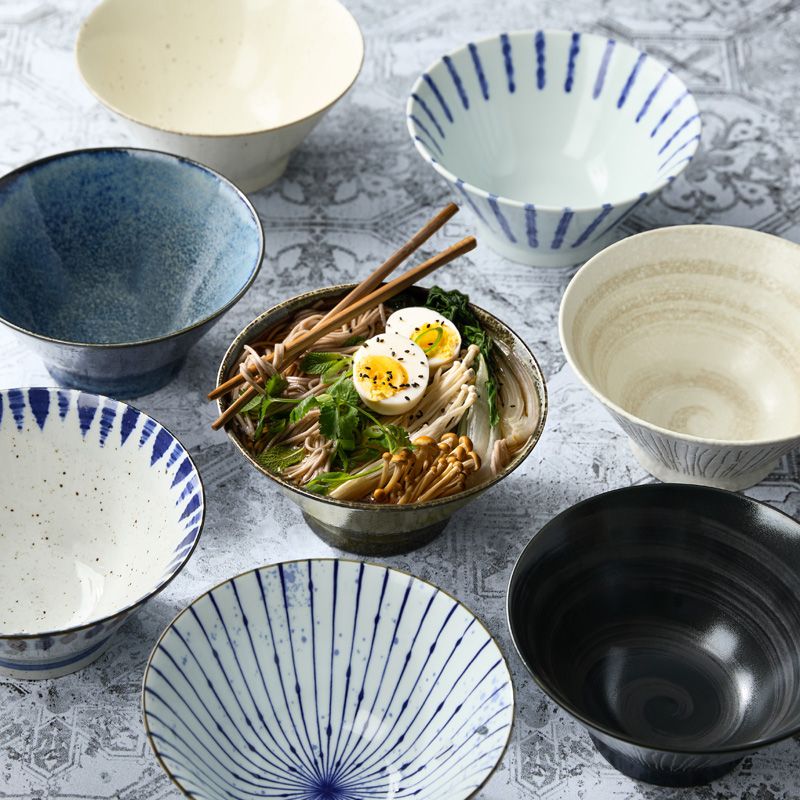
The Japanese will tell you that this sound enhances the flavours and helps cool the hot noodles as they enter the mouth. If there is a broth, it can be drunk directly from the bowl. Thick udon noodle dishes therefore deserve a bowl that does them justice.
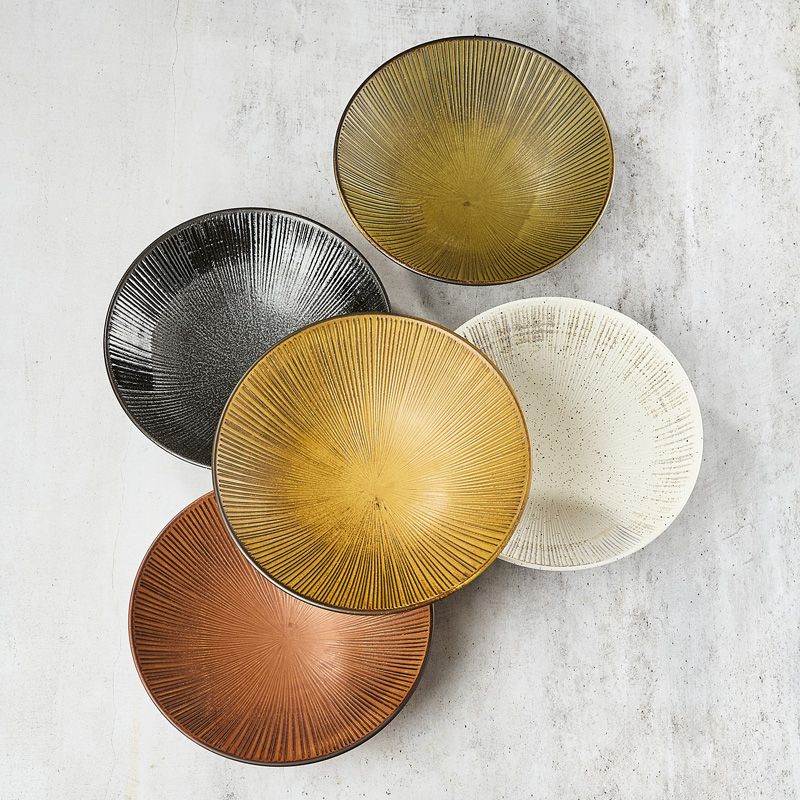
Udon need to be mixed to fully enjoy their flavours. A wider and deeper bowl allows you to toss and mix them comfortably without spilling. These thick bowls keep the udon broth hot.
Udon can be enjoyed all year round. In cold weather, udon are served hot in a rich broth. In summer, they are eaten cold or hot in a lighter broth, accompanied by fresh vegetables and tempura.
Characteristics
Storage: Keep away from heat and moisture
Weight: 0.250 g
Ingredients & nutritional values
Allergen(s): wheat
Origin
Producer: Marunaka Co.,Ltd.


