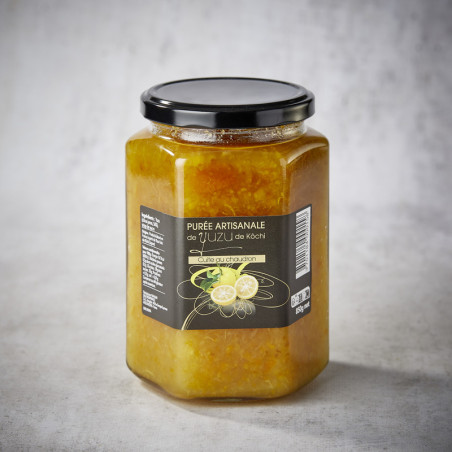
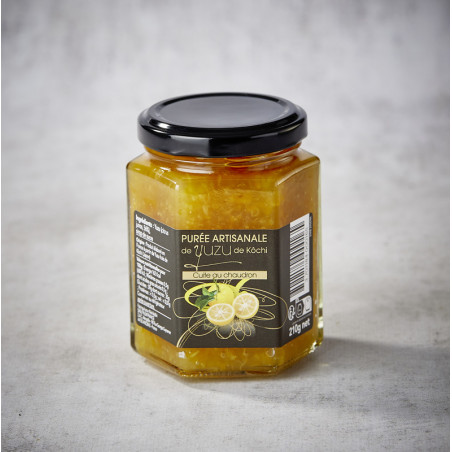
We offer yuzu, an citrus fruit from the Citrus Junos family.
The wild Yuzu or Mishoyuzu: the only trees in the wild Yuzu of Japan remain on the island of Kochi. Can measure 5 to 8 meters high, the harvest of Japanese fruits is rather difficult, they produce their first fruits after 20 years. The fruits are very rustic, of non-homogeneous colour, stained with woody marks.
Our yuzu come from Kitagawamura, a small mountainous village, according to the Japanese, the best in Japan. The Kitagawamura Mountains, in May, on the occasion of the flowering of the yuzu trees, diffuse a fragrance embalming the ambient air tens of kilometres round.
Yuzu (Citrus Junos)
What is Yuzu?
Yuzu is an agrime of the Citrus family (Citrus Junos) from a spiny tree ("pines 2-5 cm). OnefruitOf yuzu weighs 120 to 130g. It has thick, irregular skin. Its characteristic freshness and aroma are highly appreciated in Japan in the same way as lemon used in culinary preparations.
The fruits are ripe and very yellow.
Mature fruit decirse is a strong yellow to golden.
Sometimes it has some brownish or black, scaly appearance. It is a natural physiological reaction of the fruit, characteristic of the yuzu. These few unscrupulous tasks in no way alter the fruit and guarantee its authenticity. They are due to stress of the tree in the face of weather elements, to the work of the earth, or to scars of the fruit piqued by the sharp thorns of the tree.
History of Yuzu
Originally, the yuzu was present upstream of the Yangzi Jiang River in China and was transmitted to Japan 1300 years ago to the time of Nara (710-794), via the Korean peninsula. Since the end of the Heian era in Japan, exploited as a medicine. Its juice is still used as vinegar today. The scientific name "Junis" could come from "Yu no su" (Yuzu's virgin), still used in Kochi.
Yuzu Culture Region
Yuzu is grown in Japan, Korea and China, but Japan is the largest producer and consumer. In Korea, the yuzu from the Japanese tree would not offer as much flavour because of its seafront cultivation, low daily thermal amplitude and low precipitation.
Yuzu from seedlings
Formerly yuzu was cultivated in planted or natural seedlings. But the appearance of the first fruits only after fifteen to twenty years and the tree reaching five to six meters, grafting became widespread with the expansion of the crops for rapid and stable production.
We only have 5% yuzu left from seedlings in the oldest production area. For some years now, yuzu juice from seedlings has been very popular for its aroma and flavour, which are powerful, but it is not widely used because of its random yield and its small amount of extractable juice (25% versus 18% in general).
Kochi Yuzu: 50% market share in Japan
Yuzu is cultivated in the prefectures south of Miyagi. But the main production is on Kyushu Island. Kochi dominates the Japanese production market with its 50% share.
Kochi, horticulture country
With a mild climate and a good geographical location (coast bordered by the Pacific Ocean and fertile mountains), Kochi Prefecture offers many riches. Despite a high rate of afforestation and few flat terrains but enjoying a mild climate in winter.
Kôchi developed with horticulture, especially under greenhouse gardening. In recent years Kochi has positioned himself as the precursor in Japan in integrated pest management (IPM), an approach against the unintentional use of chemical pesticides by reintegrating predators of harmful insects.
Fruit growing, such as yuzu, also applies to Pomélo de Tosa, for example, where Japan has a high market share (note that yuzu production accounts for 50%).
Changes in cultivated area and production of Kôchi Yuzu
The cultivated surface of yuzu and its production in Kochi grow faster than those of other prefectures thanks to the special appreciation of its yuzu and the increased demand from Japan and abroad.
Why did Kochi become the largest yuzu production region?
We don't know exactly when the Yuzu culture started in Kochi. But it has long been known that the climate is conducive to the cultivation of yuzu thanks to the presence of wild yuzu in the mountains of Kochi. Since 1960, with the rise in national demand for yuzu, many production areas have emerged in the Kochi mountains.
The mountainous region of Kochi, where rainfall is abundant and sunshine is low, is ideal for the cultivation of yuzu which is very resistant to cold. The high thermal amplitude of the mountain climate accentuates its aroma. This is why the yuzu of Kochi, so appreciated and renowned, has become a specialty of horticultural production.
The great fame of Kochi Yuzu in Japan
20% of the production of Kôchi Yuzu is shipped to the national market as fruit. The remaining 80% are used for juice in extraction plants. It is sold to food-making companies for ponzu (vinegar or condiment), beverages, or worked in factories at production sites for the production of different products. Producers are striving to modernize their extraction and garment equipment, improve the quality of ingredients and products, and systematically monitor hygiene to gain the confidence of their customers.
Annual production and sale of Kôchi Yuzu
From the yuzu, cultivated under land in April, to the yuzu of December, which has a peak of sales during holidays, to the winter solstice until March of the following year, the yuzu is delivered all year round, which is unique in Japan and highly appreciated by the market.
Yuzu Kochi culture technique
Yuzu varieties
Among the varieties of yuzu are the "Tadanishiki", yuzu without seeds. But in Kochi, the higher varieties are selected from the yuzu from seedlings grown in several production areas such as "Nagano-kei", "Kumon-kei", or "Kiyoto-kei".
Control of yuzu crops
Among all citrus fruits, yuzu is the one that has the most random yield. In fact, fruit-cutting and harvesting work becomes particularly important. The fruit of harmful insects must also be protected. Producers are responsible for the correct use of pesticides and record production data in order to keep it stable and healthy. In addition, crops reserved for making, such as yuzu from seedlings, are based on pesticide-free size and fertilization. Some producers exploit other forms of cultivation such as organic farming.
Harvest
The green yuzu grown under greenhouses is harvested between April and June, the green yuzu open field between July and October, and the yellow yuzu between late October and late December. After harvest, the yuzu is sorted for its fruit or juice and shipped very quickly.
Performance
For field cultivation, it is possible to harvest between 15 and 20 kg of fruit (approximately 150 pieces) per tree, i.e. between 1.5 and 2 tonnes per 1000 m2 (100 trees). However, the harvest may vary from year to year, especially for old seedlings. Since yield is not stable, rarity increases its value.
Extraction of juice
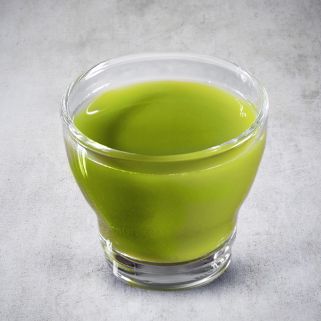
The juice extracted from a fruit usually represents 18 to 20% of the total weight of the fruit. But for the yuzu grown from seedlings, the fruit being small and the extraction rate low (15%), it is possible to obtain only 2 to 3 liters of yuzu juice per tree.
Nutritional components of yuzu
|
Main components
|
Quantity per 100 g
|
Beneficial effects of the component
|
|
Food fibres
|
Skin: 690 mg
Juice: 400 mg
|
Yuzu is rich in dietary fibers and especially pectin. Dietary fibers stimulate intestinal contractions, slow glucose absorption and help reduce cholesterol and blood sugar levels.
|
|
Potassium
|
Skin: 140 mg
Juice: 210 mg
|
Potassium maintains an ideal ion balance and cell activation.
|
|
Vitamin C
|
Skin: 150 mg
Juice: 40 mg
|
Vitamin C strengthens immunity and defenses against viral diseases.
|
|
Essential oils
|
|
Essential oils such as pinene, lemonene or citral contained in the skin of the yuzu toner the blood flow and produce a heat retention effect. In the past it was advisable to "take a yuzu bath at winter solstice" for the relaxation of the body and the prevention of colds.
|
Use of yuzu
|
Type
|
Parts used
|
Example of uses
|
|
Yuzu yellow
|
Fruit (zest)
|
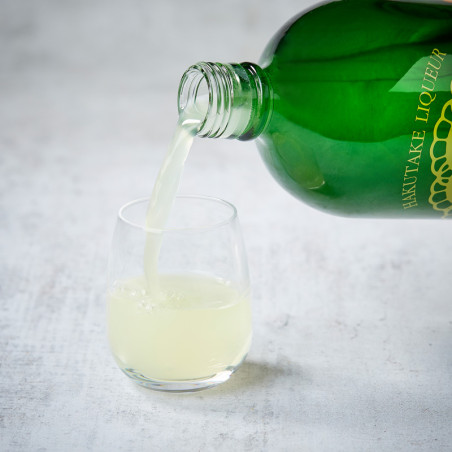
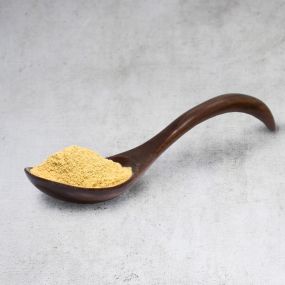
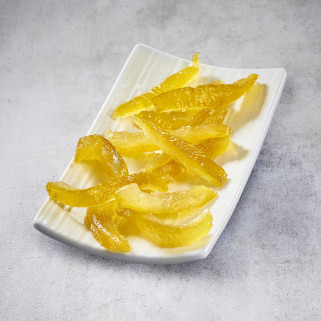
Condiments (yuzu pepper), miso yuzu, yuzu tea (marmalade), liquors, cakes, cosmetics, bath salts.
|
|
Yuzu yellow
|
Juice
|
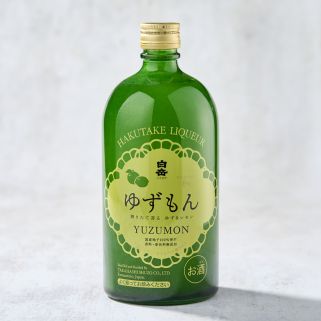
Composite vinegar (ponzu), non-alcoholic drinks, liquors, cakes.
|
|
Yuzu yellow
|
Peps
|
Cosmetic products, oils, dietary foods.
|
|
Yuzu green
|
Fruit (zest)
|
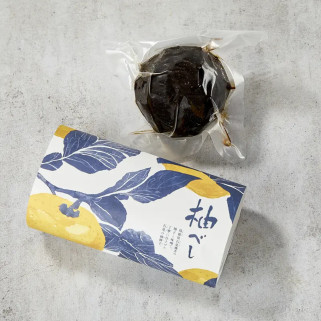
Condiments (yuzu pepper), marinated yuzu, cakes (yuzu perfume).
|
|
Yuzu green
|
Juice
|
Vinegar compound (ponzu).
|
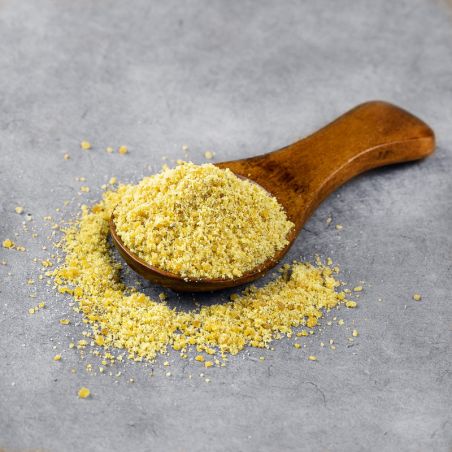
Yuzu is used in the kitchen for multiple preparations. It can be incorporated into sauces, such as dressing or use in salads, grilled fish, tofu, or barbecue. It can be used in condiments (salt, pepper), sushi vinegar, cakes, alcoholic beverages or not.
It can also replace lemon on oysters, carpaccios, cevice or tartares.
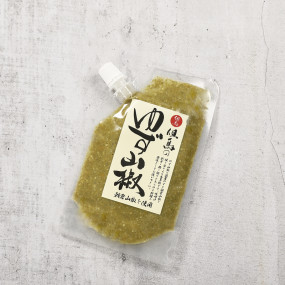
Yuzu is at the base of Japanese condiments Yuzu Ponzu and Yuzu Kosho
Its magnificent fragrance also serves to make lotions, soaps or essential oils.
What is the taste of yuzu?
The taste of Yuzu is unique, very acidic, fruity, its taste lies between the green lemon, the mandarin, the grapefruit, but it remains a very characteristic, marked, typical citrus, which must first taste.
What are the benefits of yuzu?
Yuzu is rich in vitamin C that helps strengthen immune and antioxidant defenses, which fight against aging cells. Low calorie, it is a slim ally very greedy in the kitchen.
Where to find Yuzu?
Every year at the end of the year, your Japanese grocery store Nishikidôri offers fresh Yuzu live from Japan.
What is Yuzu sauce?
Yuzu sauce is Yuzu Ponzu, a Japanese sauce very popular in Japan, rich in Umami. It consists of soy sauce, yuzu juice, kombu algae, dried bonite, mirin and vinegar.
Very easy to use, it seasons sashimi, sushi, nabe, salads of crudity, tempura, gyoza, hot soups, grilled fish, carpaccios, tartares, ceviche.