Japan is a blessed island by an abundant nature. The Japanese people developed mainly as peasants working the land and harvesting the fruits of the mountains, rivers and the ocean. They have become great lovers of a wide variety of fish and shells, vital source of protein. During this history of the development of culinary culture, the Japanese have formed and evolves their cultivation of fish consumption, since the wide variety of methods of preparations such as grilling or cooking with choked, up to the wide variety of products such as dried fish and Fish pasta. During this historical process, the Japanese tried various methods of using the Katsuobushi to prepare the Dashi, and the Katsuobushi became the key ingredient for the Dashi. What we think is the primitive form of Katsuobushi is mentioned in Japan's oldest historical chronicle, the "Kojiki" (Chronicle of Ancient Facts) of the year 712. At that time, the Katsuobushi was a commodity commodity used for Paying tax in kind because it was renowned for its long conservation. However, his method of production was probably very simple at the time; simply simply in hot water and then dried in the sun. Later, in the Samurai era, it is reported that the "Samurai" soldiers carried and ate the Katsuobushi all simple, like that; It was their ration on the battlefields. Around 1600, there was a change in the Katsuobushi production method. Traditional sun drying was replaced by smoking at the wood fire, which is what is called Arabushi now. Then, around 1800, it is believed that the Karebushi production technique appeared when we discovered that the culture of a fungus of the genus Eurotium, on Arabushi, improved its taste. This is how the Katsuobushi has become the unique Japanese ingredient. Becoming a key ingredient essential for the Dashi used in Japanese cuisine, the Katsuobushi has played an important role in the development of many local varieties of kitchens that have emerged during the "Edo" period (1600-1868). In addition, culturally, it was used as offering to the gods. As a result, it was considered a good auspicious present and a wedding gift, thus becoming an integral part of Japan's life and customs.
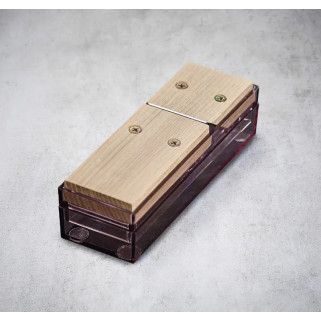
What are the qualities of Katsuobushi block compared to chips already ready?
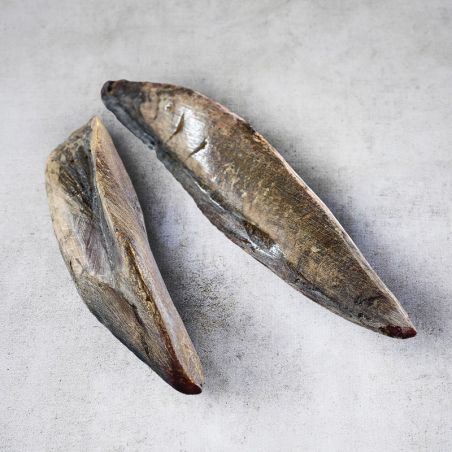
The Katsuobushi in whole pieces preserves its flavors and agrees very well if it is kept safe from light and moisture. After each use, it is recommended to pack it in food film, then set vacuum (for professionals) or in a well-hermetic container, then placed in the refrigerator, at an ideal temperature not exceeding + 5 ° C. The Katsuobushi delivered in chips loses very quickly from its flavor if it is not consumed in a very short time and if it has not been conditioned with nitrogen addition in its packaging. He tarnishes quickly and his aromas are fade. Gustatic notes become quick unpleasant. The chips must therefore be used within 8-10 days after opening the bag or after making. The use of nitrogen in the package allows superior preservation. It should be noted, however, that packaging greater than 500g are to be avoided as they do not guarantee optimum organoleptic qualities. We must keep in mind that only a freshly grated or laminated katsuobushi reveals and preserves all its aromas.
How to prepare the Katsuobushi Dashi broth?
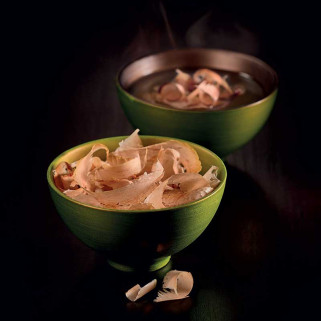
Boil 1 liter of water, add 40 g of Katsuobushi to chips and simmer for 1 minute.
Turn off the heat and let stand for 2 to 3 minutes. Drain the Katsuobushi using a colander and keep it. Keep the Katsuobushi used in the refrigerator to prepare a second portion or for other recipes. Drain excess liquid and refrigerate the used Katsuobushi (use it within 24 hours).
You can also sprinkle your chips on omelettes, broths, composed salads, okonomiyaki.








 Merchant's answer