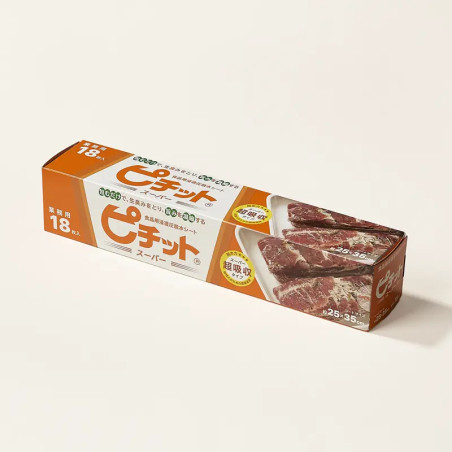
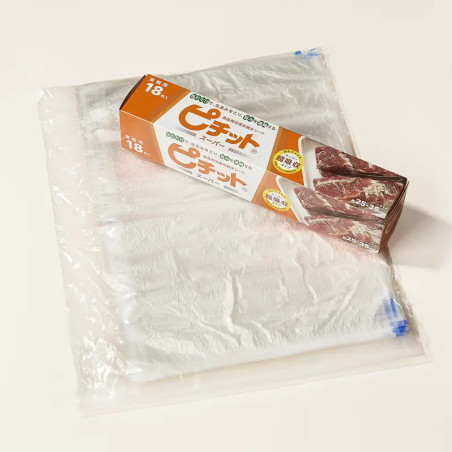
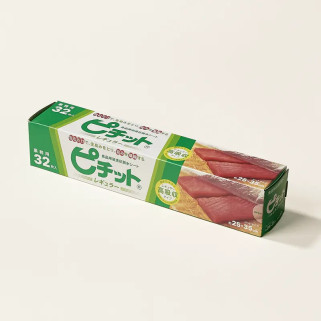
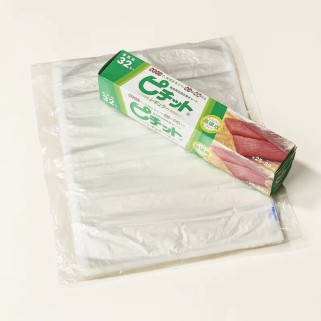
"Pichit" is a sheet that enhances the flavor of food.
The secret of "Pichit" lies in its two special semi-permeable membrane films with invisible holes, between which is sandwiched a high osmotic food syrupous component that holds absorbed moisture. This "osmotic power" is obtained thanks to the action of algae ingredients.
By eliminating the need for salt or heat, these sheets preserve the flavor by preventing cell destruction and the oxidation of lipids.
These leaves absorb moisture during freezing and thawing, allowing spices and aromas to penetrate rapidly into food and reducing cooking time. Once frozen, these leaves prevent unwanted odors from altering the flavor of the ingredients, thus maintaining the freshness of meat and fish longer.
They are used for freezing, thawing as well as drying (dehydration).
Pichit Green Box is for culinary preparations, freezing, thawing and longer drying processes. Due to its moderate absorption, it is adapted to evacuate the moisture of food during the thawing process.
Pichit orange box, high absorption is intended for the production of dried fish and dried food.
Why use the pichit leaves ?
- They eliminate excess water during the freezing of meat or seafood and prevent adverse odors as well as freezing burns.
- 70-80% of the meat or seafood are composed of water, which means that once you freeze these articles, it considerably changes the construction of the cells, and when you deconze them, the UMAMI is also evacuated with the water (or the dripping). Food defrosting using the Pichit leaf avoids this phenomenon because it absorbs only water and not UMAMI.
- They can considerably improve the texture after thawing meat or seafood, as it retains cells by effectively eliminating excess moisture.
- They accelerate the marinade process because excess moisture is eliminated.
- You can dry / eliminate excess moisture from fish without using salt, which is ideal for healthy and poor sodium cuisine.
The desiccant effect of Pichit on fish and meat:
* Frying: Reduces the splash of hot oil, promotes the obtaining of tasty fried foods, allows fast and crisp frying, and preserves the efficiency of frying oil.
* Cooking with a grill: promotes a homogeneous cooking to the heart, allows fast cooking, reduces the smoke
* Cooking over low heat: prevents food from getting riddled during cooking, facilitates the enhancement of flavors
* Smoking: Facilitates the absorption of smoke, reduces the drying time, prevents oxidation of fat
* Marinade: even small amounts of seasoning easily permeate food, which does not become aqueous even after a long time
Fish: During thawing, eliminates excess water and fish smell while enhancing flavor
For grilled fish and boiled: the dehydration time is several hours at half a day in the refrigerator
For fish, prefer fine threads, nets of nets or flesh already decided - especially during the preparation of sushi and sashimis. The flesh should be thoroughly cleaned, the blood vessels emptied and tissues free of hematomas.
Duck: Reduces the damage to meat during freezing and minimizes freezing burns during storage. Thawing meat: Dehydration time goes from half a day to a whole day in the refrigerator.
Pork chest with bacon (bacon): Reduces the ripening time in the refrigerator thanks to a strong capacity to eliminate water.
Foods suitable for Pichit
Suitable: Food with strong or unpleasant odors (eg sardines and mackerel), high water content (eg chicken leg), thawed foods (eg Frozen slopes)
Inappropriate foods: fat tuna, poor water food (eg chicken fillets), food already sprinkled with salt (eg salmon, fish eggs in brine)
The leaf pichit dehydrate by osmotic pressure unlike enzymatic aging (Dry Aging). For lean flesh (flat fish, bar, dorade, scallops, cuttlefish, squid, chicken legs), the action of Pichit leaves is fast. For fat flesh, the application will be longer (https://www.sushi-pedia.com/en/article/pichit-sheets-for-dehydrating-fish-for-sushi-or-sashimi)
It should be noted that the skin of the fish can be altered by the action of Pichit.
How to use the pichit sheet:
1. Arrange the food on the sheet. Pichit leaves have neither front nor back. You can use any side.
2. Wrap the leaf well around food. Pichit leaves can only absorb the water correctly if they are in close contact with the surface of the food.
3. Put the food in the refrigerator. Put the packed food in the refrigerator during the dehydration process.
Indicative preparation time for some foods
Water absorption time:
• Fresh sashimi (raw fish, sliced, intended for consumption) 30 to 40 minutes
• Thawing from Sashimi frozen 1 to 2 hours
• Fried fish 15 minutes to 1 hour
• Grilled fish or boiled 2 to 4 hours
• salted fish and dried during the night (Ichiya-Boshi) half a day to a day (after being sprinkled with salt)
Preparation of raw fish, raw meat, etc. : Pichit leaves eliminate excess water and enhance the flavor of raw fish, raw meat, etc. They also eliminate odors characteristic of raw meat.
Fish fillets (https://www.sushi-pedia.com/en/article/pichit-sheets-for-dehydrating-fish-for-sushi-or-sashimi):
Reference values for fish contact dehydration with the Pichit green sheet, depending on the grease cut and grease content. Cutting fat duration Duration
Thick net 7-13 h
Middle net 5-10 h
Filet 2-6 h
Sashimi thick 3-5 h
Sashimi average 2-3 h
Sashimi late 1-2 h
Food preservation by freezing: Pichit leaves eliminate water and smells of raw fish and meat during freezing foods, which reduces fish and meat damage and minimize the risk of burns of freezing or other damage related to cold.
Food thawing: Pichit leaves eliminate water and smells of raw fish and meat while defrosting food in the refrigerator, which reduces juice flow and get a beautiful color.
Salmon back or salmon net:
Eliminates excess water during thawing, enhances the flavor and improves the color.
Thawing of Sashimi (raw fish): Dehydration time between 40 minutes and 2 hours in the refrigerator. Dehydration rate: 2% to 4%
Boneless chicken leg
Eliminates the smell of raw meat and promotes the penetration of aromas.
Chicken preparation
Dehydration time: about 1 hour in the refrigerator
Sea food
Eliminates excess water while thawing and reduces the splashing of frying oil. Also decreases the alteration of the oil.
Thawing shrimp and scallops: Dehydration time until mid-thawing or complete defrosting in the refrigerator
The pischit sheet eliminates excess water and smell of raw meat while maintaining the flavor and improving the color.
Osmotic pressure protects food
Pichit leaves use a permeation effect to eliminate water and raw food meat odors and enhance the flavor through the extraction of moisture by osmotic pressure.
Preparation of raw fish, raw meat, etc.
Pichit leaves eliminate excess water and enhance the flavor of raw fish, raw meat, etc. They also eliminate odors characteristic of raw meat.
Food preservation by freezing.
Pichit leaves eliminate water and smells of raw fish and meat during freezing food, reduce damage to fish and meat and minimize the risk of freezing burns or other related damage. Cold.
Food thawing
Pichit leaves eliminate water and fish smells and raw meat while defrosting food in the refrigerator, which reduces juice flow and get a beautiful color.
What results do we observe with different ingredients ?
Here is the professional expertise of Sushpedia
(https://www.sushi-pedia.com/en/article/pichit-sheets-for-dehydrating-fish-for-sushi-or-sashimi):
In the preparation of sushi and sashimis, it is common to sprinkle salt ingredients (shiojime, 塩締 め, salting) or sugar (Satōjime, 砂糖締 め, sucking) before processing. Sprinkler extracts water and other substances from the flesh, which can improve flavor and smell. However, this produces a potentially unwanted salty or sweet aftertaste. To eliminate it, the flesh is then rinsed with water or saké (酒) brewed from polished rice. This rinsing, however, causes some moisture reabsorption. The use of the Pichit sheet offers the possibility of completely from salt or sugar: the flavor is preserved and the compounds responsible for the odor are reduced.
High and wild
All ingredients do not win in flavor through the use of the Pichit Sheet. In addition to particularly fat fish, livestock fish can be problematic. Depending on the quality of the water and the composition of the feeding, these can have an important undesirable taste. If this taste is only subtly present in freshly slaughtered specimens, dehydration can intensify it: the elimination of water concentrates all dissolved substances in tissues, including unwanted taste components.
Atlantic farming salmon (Sāmon)
Several atlantic farming salmon tests (Sāmon, サーモン) have shown that the high fat content prevents sufficient water absorption. The differences in flavor after five hours (whole song / net) were minimal. It is only after a 30-hour application that an improvement in the flavor appeared. The duration of application therefore significantly exceeds the general reference values indicated in the table, which is explained by the particularly high content of intramuscular fat from the breeding salmon. Best results have been obtained with softer salmon flesh - the pieces from the lean are therefore preferable.
Tuna (Maguro)
The lean tuna flesh (Akami, 赤身) gains substantially flavor when combined with Pichit. After only one hour, a perceptible improvement of the consistency and intensity of the flavor is obvious. With a longer application, the flesh becomes much firmer and the color intensifies. The greater the flesh, the less the improvement made by the pichit is pronounced.
Marinated tuna (Zuke Maguro)
For the preparation of the Zuke Maguro (漬け マグロ, soy sauce tuna), thawed thawed Saku blocks of yellowfin tuna and red tuna were used. For lean flesh, a dehydration time of two to three hours is a good base for the marinade.
The treatment with the Pichit sheet allows the marinade to penetrate more deeply in the flesh.1 In our application, the dehydrated tuna flesh was then put under vacuum in a bag and marinated in soy sauce (shōyu, 醤油) for 2 to 3 hours. As a reference, a proportion of soy sauce about a quarter from the weight of the flesh proved effective.
Japanese Serole (Buri, Hamachi)
The results obtained with the Japanese serial flesh (Buri, 鰤) vary considerably depending on personal preferences. In the Japanese Jeune Livestock - called Hamachi (ハマチ) - the texture has become firmer, the smell has mitigated and the flavor has intensified, the umami note becoming more distinct thanks to the concentration. In wild fish or larger specimens, the improvement was less pronounced. When thawing frozen breeding hamachi, the Pichit sheet proved useful. Due to the generally higher fat content, much longer application times are expected.
Dorade (Tai)
Sushipedia. Preparation of Madai sushi with the film Pichitto. All rights reserved ©
The flesh of the doorard (Tai, 鯛) has a water content well adapted to Pichit. The red dauade (Madai, 真 鯛) that we used came from Japanese farms and was of good quality. The fillet flesh was already unwanted odorless odor before the application - tender and tasty. Thanks to Pichit, the flesh has lost a significant amount of water and has become pleasantly firmer. The slightly sweet flavor has intensified and the mineral notes have gained in the presence.
Flatfish
The flesh of most flat fish, such as the hirame (鮃), has a relatively high water content, which makes treatment in pichit a natural choice. The flesh wins in firmness in a short time and the mineral flavor intensifies. This treatment is particularly useful during the seasons where the flesh has a higher fat content, because the "feeling of melt in the mouth" is preserved despite increased firmness. Fine flesh, however, loses its humidity relatively quickly; The application time should not be excessively long, otherwise lose too much of the delicate texture. For larger specimens fished during the cold season, a period of application of five to seven o'clock has proven to be an appropriate reference value. The texture obtained is comparable to that obtained by treatment with kobujime.
In the case of oily flesh - like that of Greenland halibut - the term of application is extended. Flat fish caught in winter can also present a greater content higher than those caught in summer.
Japanese Bar (Suzuki)
The Japanese bar (Suzuki, 鱸) lends itself as well to pichit and kobujime. The flesh has a high water content, which reduces the duration of application. It is usually a little longer than for kobujime. Dehydration makes the mineral flavor slightly more pronounced and the flesh wins in firmness. With the Suzuki, however, the texture is a determining quality indicator: the flesh is characterized by its fine, almost delicate structure. The degree of strengthening due to water loss must therefore be carefully evaluated, as too long application can alter the feeling in the mouth adversely.
Calmar (IKA)
Calmar (IKA, 烏賊) is characterized by a soft and gelatinous texture that quickly reacts to Pichit leaf treatment. Short application times, one to two hours, generally make it possible to obtain a firmer texture without the product taking a dried appearance. Longer applications tip the result towards the dried fish domain, an effect that has been used in the preparation of the salt-reduced himono
Walnuts of Saint Jacques (Hotate)
The Scallops (Hotate, 帆立) shell is suitable for pichit leaf treatment, especially when the frozen scallop refrigerated thawing. Application times of about two hours generally allow the product to maintain its characteristic firm texture while absorbing exudate.