Sanriku coastline, with its ria, is the source of its value. On the ria, where sea and mountains are closely intertwined, rainwater that has fallen over a long period seeps deep into the earth and produces mineral-rich water in the bay. In addition, this region is one of the three most fertile fishing grounds in the world, where Oyashio and Kuroshio currents meet.
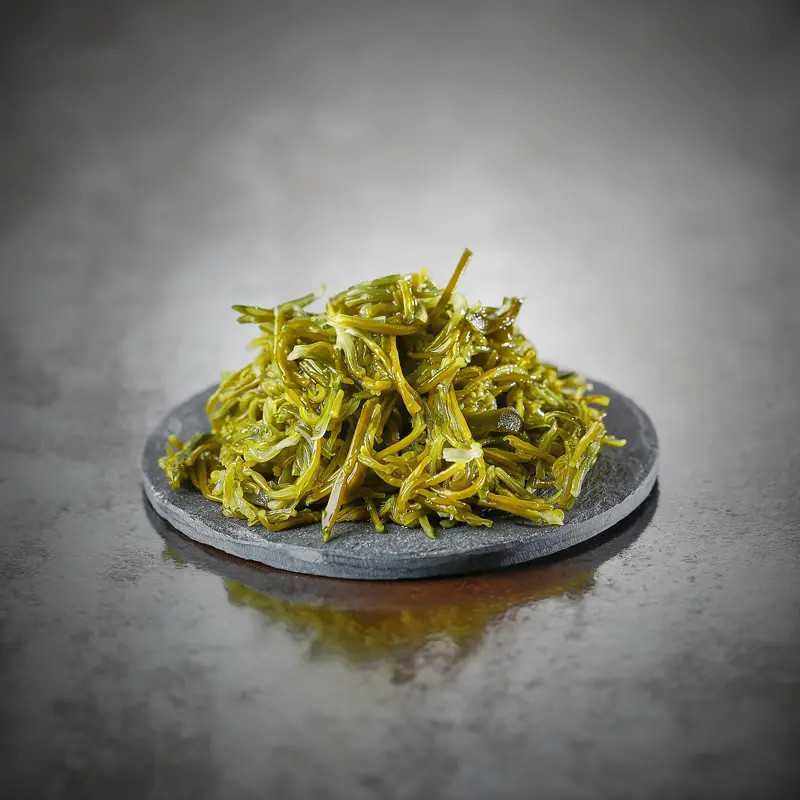
These diverse conditions make Sanriku coast an ideal environment for growing Sanriku mekabu. This seaweed absorbs sufficient nutrients in Sanriku region to become a thick, firm mekabu, very sticky and aromatic. Other seaweeds thrive here, such as kombu, funori and black bara nori.
This ria is also particularly well-suited to sea urchin farming. Mekabu is part of wakame seaweed stalk. It is rich in fucoidan, on which medical research is currently being conducted to prove its health benefits. Mekabu is produced all over Japan, from western Hokkaido to Kyushu, but Miyagi and Sanriku prefectures in Iwate alone account for almost 70% of national production.
There are two major differences between “Sanriku mekabu” produced by Kita-Sanriku factory and mekabu from other regions. First is its large folds, thickness and good texture. Other is its strong stickiness and aroma. Thanks to these particular characteristics, Sanriku mekabu is known as a local specialty.
Sanriku coastline, with its ria, is source of its value. On the ria, where sea and mountains are closely intertwined, rainwater that has fallen over a long period seeps deep into earth and produces mineral-rich water in the bay. In addition, this region is one of three most fertile fishing grounds in the world, where Oyashio and Kuroshio currents meet.