favorite_border
      Miso White Kantoya
      Miso White Kantoya
      Miso White Kantoya

      Miso White Kantoya

      Ref : NISMK1

      €3.95
      Tax Included
      €39.50 / Kg

      Short date: 15/05/2026

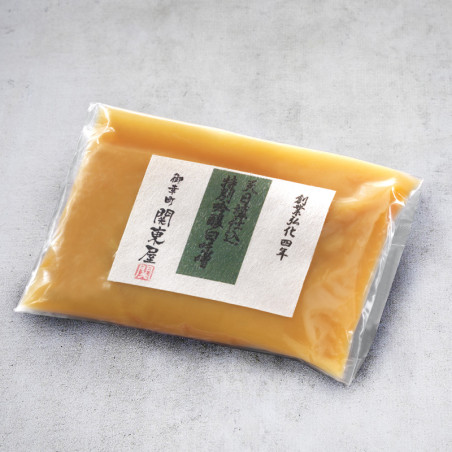
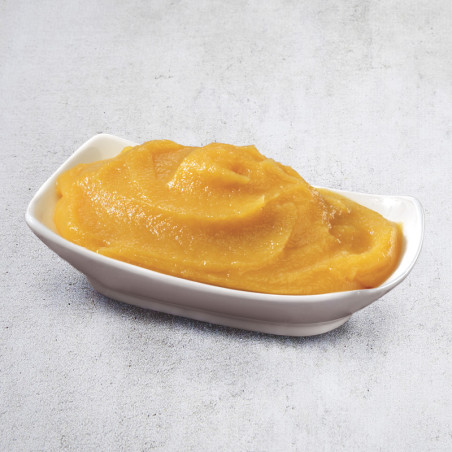
      The miseo is a special mise developed by focusing on the sweet. Other miso have been developed for conservation. This white miso dough is drawn traditionally.

      Packaging :
      Quantity :
      In Stock

      A traditional sweet white mise

      The real name of this miseo is "Tenpi-Shio Jikomi Tokubetsu Ginjo Shiro-Miso". It is Kantoya's most popular white misse.
      The miseo has a salt content equal to a third of that of the normal miso. He uses twice as many Kôji rice than the usual miso to get a delicate sweet taste.
      Its fermentation method is also different: it does not use yeast for its fermentation to give a delicate flavor with a sweet note of soy.

      He has a denser flavor with a chestnut flower note.

      Our perfect agreements

      Fabulous for the realization of miso soup "Shiro Miso".
      Usually used for sweet type miso soup and zoni, and as an ingredient for Miso Dengaku or the Miso Vinegroute. It contains less salt (about 5%) and can be mixed with other miso to soften the taste of the Miso soup.
      To taste in traditional miso soup with tofu dice, chive or chopped hop.
      The miseo is also surprising for mariner meat and fish (an enzyme named protease that is found in the Miso Saikyo transforms the protein from amino acid ingredients such as glucic acid and glycine and makes the fish and the Delicious meat).
      You have to marinate 12 to 24 hours.
      The salt contains a significant level of minerals that make the mise rich and tasty.
      By mixing with sweet ingredients, the miseo reveals its sweetness. It goes well with dairy products such as milk and cheese. It has greater resistance to heat and can therefore be used to simmer.
      In case of temperature too high, the maillar reaction of sugars occurs and it becomes brown and bitter. In addition, when stored at more than 25 ° C, the protein contained in the Miso becomes also brown because of the maillard reaction, resulting in the degradation of the quality of the miso and a decrease in its flavor.


      Learn more about Japanese miso 

      NISMK1

      Data sheet

      Origin
      Kyoto, Japan
      Type
      White Miso
      Weight
      1 kg net
      100 g net
      500 g net
      Packaging
      bag
      Ingredients
      rice, soy, salt, alcohol, vitamin B2, aspergillus oryzae
      Storage
      Freeze for longer storage (12 months)
      keep refrigerated
      Allergenic(s)
      soya
      Nutritional values
      Per 100 g : energy 227 kcal (959 kJ) ; fat 5,3g, of which saturates 0,9g ; carbohydrate 36g, of which sugars 30g ; protein 8,9g ; salt 4,0g.
      KANTOYAKANTOYA

      The Kantoya house, created by Chube Kantoya San, has been dedicated to making miso since 1847, 6 generations, in its workshop located south of the former imperial palace, the center of the Kyoto city.

      Made miso has a taste that can only be created with the care and efforts of its craftsmen. They only use groundwater from the Hiei Mountain, 60 meters deep. The preferred manufacturing processes involve many artisanal operations.

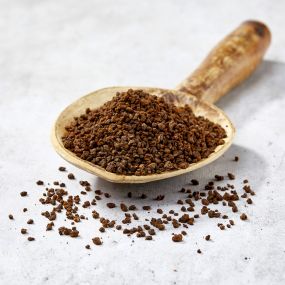
      Another example of the care they bring to their miso lies in the quality of kôji. Kôji is one of the key ingredients of miso: it brings a sweet taste by its glycation and increases the umami of miso, that is to say its flavor, by breaking down the proteins of soy. It takes three to four days to produce a kôji. During this period, kôji is carefully worked four times by human hands. The manual work is privileged because it allows to feel the effects of living kôji mold, which evolve every day. Being in touch with kôji makes all the difference.

      KANTOYA miso is mainly used by Japanese restaurants and Kyoto confectioneries. Many of them have been implanted for a long time, and this for several decades. Today, the number of users of their miso is increasing thanks to long-standing customers who open new restaurants or generously introduce new customers.

      Our master craftsmen think that miso plays a fundamental role in deciding the taste of dishes and confectionery. However, the taste is not always uniform depending on the variety, the growing area and the year of production of ingredients such as rice and soy. The role of KANTOYA is to facilitate collaboration between such miso and great chefs, who always try to cook the best dishes. They listen to each client's word and see their changing needs through close, long-term communication and provide them with the best miso.

      The origins of white miso “shiro-miso” or "Saikyo-Miso"

      From the 8th to the 17th century (from the Heian period to the Edo period), Kyoto, residence of the Emperor, was the capital of Japan and all the powers were concentrated in the city. Many "kuge" (court nobility) lived there and had good land all over Japan where they cultivated quality rice and were honored.

      Using this type of rice, miso was once a high-salt conservation food. However, people noticed that with a higher rice content and a lower salt content, miso became very sweet. At that time, sweet condiments derived from trees or fruit were very valuable because there was no sugar. Having discovered that miso could be very sweet, they began to use it as well as these famous sweet condiments. It was used only in the imperial court, which would correspond to the beginning of the white miso in Kyoto.

      At that time, white miso was also used as an ingredient in dishes served to deities during court rituals. The recipes of these dishes are also used in today's rituals as well as in many events for the general public: Zoni (rice cake soup) tasted at New Year, kashiwa-mochi (rice cake wrapped in a oak leaf) consumed at the Boys Festival in May, gyoja-mochi (ascetic rice cake) savored at the Gion Festival, and aburi-mochi (cooked rice cake) sold in the tea rooms in front of the temples. White miso has evolved differently from other types of miso. It has developed as a sweetener and its preservative quality has been sacrificed. This is why white miso is often used not only for cooking but also for confectionery.

      In the Meiji era, the capital of Japan was moved from Kyoto to Tokyo and many court nobles, including the Emperor, moved to Tokyo. However, there was no such sweet white miso in Tokyo because it was a city of war culture. The nobles liked it all the sweet white miso of Kyoto and began to call it "Saikyo-Miso" (miso of the capital of the West). Even today, the white miso is called "saikyo-miso", but only "shiro-miso" (white miso) by the inhabitants of Kyoto.

      Japanese people life is divided into two categories: "hare" and "ke". "Hare" means special and festive day and "ke" means ordinary day. Since ancient times, people have been eating special and precious foods such as rice balls, sekihan (festive red rice), sake and confectionery with special dishes. The Kyoto white miso played an important food role during these special days and developed through the rituals of the Court.

      Reviews about this product
      Logo Société des Avis Garantis Show attestation

      Reviews subject to control

      0
      1★
      0
      2★
      1
      3★
      0
      4★
      14
      5★
      9.8/10


      Based on 15 reviews

      • 5

        I haven't tried it yet (Translated review)

      • 5

        Very good (Translated review)

      • 5

        This miso is pure delight! I've never had such good quality (Translated review)

      • 5

        Very good and incredibly sweet. (Translated review)

      • 5

        Excellent product! (Translated review)

      • 5

        The best miso I have ever tasted. (Translated review)

      • 5

        White miso, with a very fine taste, and pleasantly sweet. (Translated review)

      • 5

        Perfect, good value for money! (Translated review)

      • 5

        The best white miso I have tasted so far! (Translated review)

      • 5

        very good (Translated review)


      Related Products
          from €42.50
          €42.50 / Kg
              from €11.80
              €59.00 / Kg
                  (4 reviews)
                  from €12.80
                      from €16.50
                      Kantoya sweet rice miso paste
                      Miso White Kantoya
                      €3.95
                      Tax Included
                      €39.50 / Kg
                      • Traceability and origin Authenticity and perfect traceability

                        Traceability and origin

                        Authenticity and perfect traceability

                      • Fast Delivery

                        Fast Delivery

                      • Payment 100% secure

                        Payment

                        100% secure

                      • Customer service At your service

                        Customer service

                        At your service

                      Newsletter

                      You may unsubscribe at any moment. For that purpose, please find our contact info in the legal notice.