









The term "Katsuobushi" commonly refers to smoked and dried bonito. Katsuobushi comes in several secondary products, each bearing a different name depending on the stage and degree of its elaboration.
The dried bonito (Katsuwonus pelamis) that has been boiled, smoked and dried is called arabushi. When the arabushi is planed and trimmed to improve its shape, it is then called hadakabushi. By subsequently cultivating a mould (microscopic fungus) on the hadakabushi two or more times, karebushi is obtained.
The generic term for these products is katsuobushi.
The history of dried bonito:
Since the end of 2013, Washoku, or the culinary traditions of the Japanese, has been inscribed on the UNESCO Intangible Cultural Heritage of Humanity, news that was welcomed with joy in Japan.
When speaking of Washoku, or Japanese cuisine, dishes such as sushi, sukiyaki, tempura, soba and udon often come to mind. It is possible that some dishes you regularly consume are adapted versions of Japanese recipes, adjusted to local taste.
Today, Washoku is enjoyed throughout the world. It can be said that the secret of this cuisine lies in the dashi (meaning soup stock), which is the base of many Japanese dishes, just as stock is the base of Western cuisine.
Dashi is the equivalent of Washoku. It is prepared with ingredients such as katsuobushi (smoked and dried bonito) and kombu (dried seaweed). Today everyone can consume a wide choice of food from around the world and is confronted with a multitude of information on a great variety of products. Consequently, in promoting Washoku, Japan has a responsibility to provide accurate information about the dashi used in this cuisine and its flavours. The foundation of Washoku is dashi, and the most popular type of dashi is katsuobushi dashi (dashi made with katsuobushi).
For centuries and up to the present day, the Japanese have developed a unique culinary culture in which fish plays a primordial role, especially katsuobushi, which is made by simmering bonito in hot water, then smoking and drying it.
This ingredient has long been a favourite among the Japanese, appreciated for its delicious flavour and long shelf life.
Dried bonito and Katsuobushi Dashi: why do the Japanese love them?
Japan, an island blessed with abundant nature, saw its people develop as farmers exploiting the riches of the mountains, rivers and ocean. The Japanese became great lovers of fish and shellfish, vital sources of protein.
Over the centuries, the Japanese perfected their culinary culture around fish, using a wide variety of preparation methods, such as grilling or braising, and producing dried fish and fish pastes. Among these practices, the use of katsuobushi to prepare dashi became central, making katsuobushi a key ingredient in Japanese broth.
The primitive form of katsuobushi is mentioned in the "Kojiki" (Chronicle of Ancient Events) of the year 712. At that time, katsuobushi was a precious commodity, often used to pay taxes in kind, owing to its long shelf life. Its production was then very simple: simmered in hot water and dried in the sun.
Later, in the era of the Samurai, it is recorded that soldiers carried and consumed katsuobushi as it was, as a ration on the battlefield.
Around 1600, the method of producing katsuobushi evolved. Traditional sun-drying was replaced by wood-fire smoking, creating what is known today as arabushi. Around 1800, the technique of producing karebushi emerged: it was discovered that cultivating a fungus of the genus Eurotium on the arabushi improved its flavour. Thus, katsuobushi became a unique ingredient in Japan.
A classic and essential ingredient for the dashi used in Japanese cuisine, katsuobushi played a crucial role in the development of many varieties of local cuisines during the Edo period (1600–1868). On a cultural level, it was also used as an offering to the gods, considered an auspicious gift and a wedding present, thus becoming an integral part of Japanese life and customs.
Dried bonito and Umami:
Like sweet, salty, sour and bitter, Umami is the fifth taste category, identified for the first time by Japanese scientists. Today, Umami is recognised as a common taste worldwide.
Glutamic acid, an amino acid classified as Umami, was discovered in kombu (dried seaweed) in 1903. In 1913, Japanese scientists also identified inosinic acid, a nucleotide acid classified as Umami, in katsuobushi. In 1960, it was discovered that awase dashi (mixed dashi), prepared from katsuobushi and kombu, intensified Umami through the interaction between the inosinic acid in katsuobushi and the glutamic acid in kombu.
This powerful Umami interaction enhances the flavour of food even with a small amount of salt. Thus, one of the reasons for the Japanese preference for katsuobushi dashi has been scientifically confirmed.
Does the production reserved for export have the same organoleptic qualities as that dedicated to the Japanese domestic market?
The product is different because the smoky notes are much less pronounced. The product is more refined, offering a subtle and elegant flavour with less marked acidity. Many Japanese chefs recognise the quality of this product and are often astonished by its exceptional results. It is also healthier, with no benzopyrene saturation or Eurotium moulds. It is nevertheless perfectly recognised by many Japanese chefs, who are very surprised by the result obtained.
In Western cuisine, its use will be easier as the smoky notes and the powerful bonito notes are replaced by more delicate accents accessible to all.
Does this product require particular logistical requirements?
Katsuobushi requires specific logistics, with transport under controlled refrigerated temperature, whether by sea or air. To guarantee its quality, it is crucial that the temperature does not exceed 5°C during long-distance journeys. It is stored in a cold room in France, but it can be shipped at ambient temperature to professionals if delivery times are less than 5 days. However, refrigerator storage is recommended.
Quantities are currently limited.
What are the differences in use between bonito in a block and bonito in shavings?
The applications are entirely the same whether in a block or in shavings. The difference lies in the fact that, to use the bonito in a block, you will need a grater to obtain shavings.
It is important to maintain the katsuobushi block at a 60-degree angle to make the most of the piece, and one must never grate it by positioning the piece flat on the grater.
The benefits of Katsuobushi:
Bonito is very rich in nutritional values. Indeed, 20% of the composition of the human body is made up of amino acids, which play a crucial role in the formation of muscles, vital organs, bones, nerves, blood and skin. Among the 20 essential amino acids, 9 cannot be produced by the human body and must be supplied through diet. What is remarkable about katsuobushi is that it contains these 9 essential amino acids in balanced proportions.
Furthermore, katsuobushi is particularly rich in docosahexaenoic acid (DHA), an important nutrient for cognitive development and function, and in eicosapentaenoic acid (EPA), recognised for its preventive properties against thromboembolic disorders such as phlebitis and blood clots.
The production process of typical katsuobushi:
The katsuobushi production process is complex and time-consuming. It takes approximately one month to produce Arabushi and two to six months to finish karebushi, the fermented version. Although modern production equipment has been partially adopted and productivity and hygiene have been improved, the basic process remains unchanged since ancient times.
Katsuobushi is prepared by skilled craftsmen who take great pride and confidence in their production of this traditional ingredient, which has played a key supporting role in Japan's culinary culture. Today, most katsuobushi is produced in the city of Makurazaki and in the Yamagawa district of the city of Ibusuki (both in Kagoshima Prefecture on the island of Kyushu in the south) and in Yaizu (in Shizuoka Prefecture, south of Tokyo).
Description of the five key traditional steps in the production of dried bonito or katsuobushi
- Step 1: Cutting (Namagiri)
Begin by removing the heads of the bonito and gutting them in preparation for cooking.
- Step 2: Cooking (Shajuku)
The bonito fillets are boiled for approximately one hour in water heated to a temperature of 85 to 95°C. This process deactivates the enzymes present in the flesh, prevents decomposition and coagulates the proteins.
- Step 3: Cleaning (Honenuki)
Remove the bones, fins and scales.
- Step 4: Smoking (Baikan)
The bonito fillets, now boiled and cleaned, are exposed to wood smoke. This process is repeated until the moisture content of the fillets drops to no less than 26%. The product obtained is arabushi, a highly aromatic smoked food.
To obtain Karebushi, the arabushi is planed and mould cultivation is carried out two or more times (Kabitsuke process). The product obtained is called Karebushi.
As the production process described above shows, katsuobushi is a product made from 100% bonito and nothing else. The absence of added salt, condiments or preservatives sets it apart from other smoked products.
The advantages of the smoking process
The repeated smoke-drying of the bonito after simmering confers a very distinctive aroma to the katsuobushi.
Furthermore, the phenolic substances contained in the smoke prevent the oxidation of fats. Fish fats oxidise particularly quickly and are liable to deteriorate. Unless smoke-dried, the bonito fillets would deteriorate quickly and would never develop the pleasant flavour of katsuobushi.
The primordial role of mould (microscopic fungus)
The mould cultivation process plays a primordial role in determining the flavour of Karebushi. During this step, a mould of the genus Eurotium selected for its remarkable qualities is cultivated, which serves to further reduce the moisture still contained in the katsuobushi after drying and smoking. Furthermore, the lipolytic enzymes contained in the mould break down the fat in the fillets, thereby giving greater transparency to the dashi.
Etymology of the word katsuobushi
Firstly, dried smoked fish is generally called "Fushi".
Secondly, bonito is called "Katsuo".
You may be beginning to understand, since the smoked and dried fish (Fushi) is made with bonito (Katsuo), hence the Japanese name katsuobushi (Katsuo + Fushi; the combination of the two words slightly changes the pronunciation).
Correct storage necessary for the preservation of flavour
When buying katsuobushi and wishing to keep it for a long time, one must take the precaution of protecting it from mould (different from the beneficial mould) and insects. Katsuobushi must be stored in the refrigerator in airtight vacuum-sealed packaging.
When buying Kezuribushi (fine katsuobushi shavings) and the packet has been opened, it must be resealed airtight with the air removed and placed in the refrigerator. If the packet is small, it is recommended to consume it entirely in one go.
The problem is that if you keep katsuobushi or an open packet of Kezuribushi, the katsuobushi will oxidise on contact with the air and its aroma will deteriorate. Be careful!
How to use Katsuobushi in cooking?
Katsuobushi comes in several forms and applications in Japanese cuisine. In former times, in Japan, people bought katsuobushi in a block and grated it themselves before using it to prepare dashi or other dishes. Today, there are convenient versions that make it easier to use.
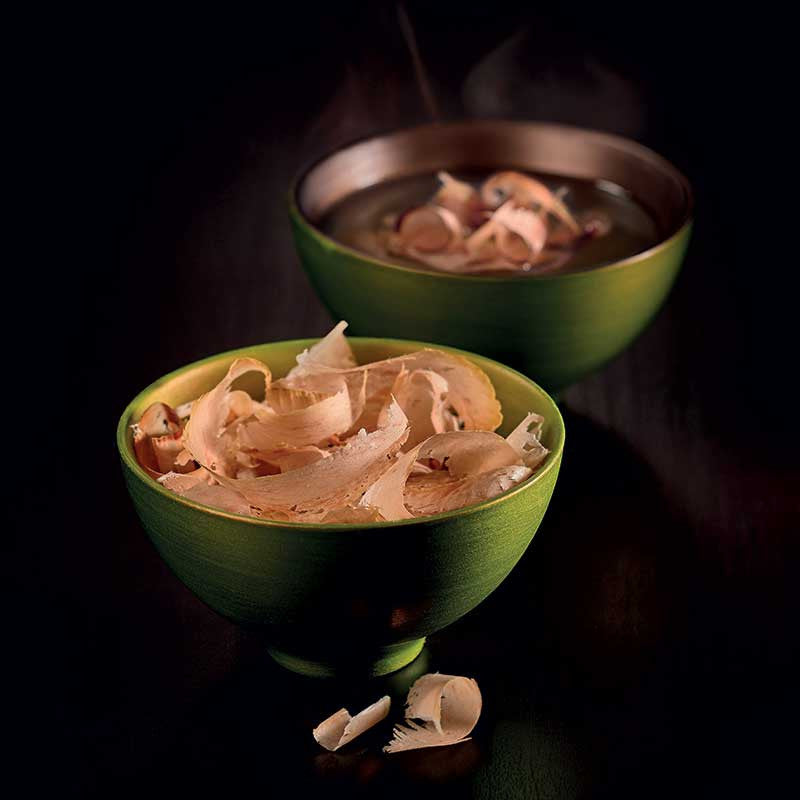
The most common form today is Kezuribushi, or katsuobushi shavings, sold in packets in Japanese food shops. This ready-to-use product allows dashi to be prepared without having to grate the katsuobushi oneself. Kezuribushi comes in different thicknesses, shapes and sizes, adapted to the varied needs of consumers.
There are also other convenient options for preparing katsuobushi dashi:
- Katsuobushi powder: This instant condiment, prepared from pulverised katsuobushi, is used to make dashi quickly.
- The liquid condiment: Prepared with katsuobushi dashi, this product is ideal for seasoning noodle soups such as Soba, Udon, Somen, or Ramen.
These varied products make it possible to incorporate katsuobushi dashi into a wide variety of Japanese dishes, including Miso soup, simmered dishes such as Nimono, and Japanese stews such as Nabe. Katsuobushi is also a key ingredient in specialities such as Tamagoyaki (Japanese omelette), Chawanmushi (steamed egg custard), Okonomiyaki (Japanese savoury pancake) and Takoyaki (octopus balls).
How to prepare katsuobushi dashi?
The instructions given below are for preparing dashi with Kezuribushi (finely shaved katsuobushi).
Have 30 g of Kezuribushi and 1 litre of water to hand.
- Bring 1 litre of water to the boil in a saucepan.
- Add 30 g* of Kezuribushi to the saucepan.
Turn off the heat immediately.
*The recommended ratio is 3–4 parts Kezuribushi to 100 parts water.
- The Kezuribushi will quickly sink to the bottom of the saucepan. Once done, strain the liquid through a cloth or a fine-mesh sieve.
You now have the delicious dashi.
How to make awase dashi with a mixture of katsuobushi and kombu (dried seaweed)
The instructions given below are for preparing awase dashi (mixed dashi) with katsuobushi and kombu seaweed (dried seaweed). Have to hand 30 g of Kezuribushi (= fine katsuobushi shavings), 10 g of kombu and 1 litre of water.
- Begin by wiping any traces of dirt from the surface of the kombu with a soft, clean cloth. Place the kombu in a saucepan and pour the water over it.
- Place the saucepan over a low heat and gently warm the water and kombu. Just before the water begins to boil, remove the kombu from the saucepan.
- Then add the Kezuribushi (fine shavings of Katsuobushi) to the same saucepan. Turn off the heat and wait for the Kezuribushi to sink to the bottom. Once done, strain (filter) the liquid through a cloth or a fine-mesh sieve. You now have the delicious dashi.
Using Kezuribushi allows you to quickly prepare the delicious katsuobushi dashi, which is the basic stock used in Japanese cooking, such as for Nimono (simmered vegetables) and Nabe (Japanese stew). By adding shoyu (soy sauce), mirin (sweet sake seasoning) and sugar to the katsuobushi dashi, you will obtain a good soup for Soba noodles. Furthermore, you can enhance the flavours of the dashi by blending the katsuobushi dashi with other dashi made from other smoked and dried fish such as Saba (mackerel) or Soudagatsuo (frigate tuna).
Using katsuobushi as a garnish:
Beyond the use of katsuobushi dashi in cooking, another common use of katsuobushi consists of sprinkling Kezuribushi as a garnish on food. Have you ever seen video footage of "Dancing katsuobushi" on ready-made Japanese foods such as Takoyaki (octopus balls) or Okonomiyaki (Japanese savoury pancake containing a variety of ingredients)? The Kezuribushi expands and contracts under the influence of the hot steam from the food, giving the impression that it is dancing, hence the name "Dancing katsuobushi". Needless to say, the use of katsuobushi as a garnish is not limited to topping Takoyaki and Okonomiyaki. Some dishes are served with fine strips of Arabushi with its rich aroma, or sprinkled with Karebushi with its exquisite sweetness.
Today, the use of katsuobushi extends beyond Japanese cuisine. Japanese chefs are taking up the challenge of using katsuobushi in non-Japanese dishes, each following their own inspiration. At the most basic level, given how much it pleases the Japanese palate, it is certain that katsuobushi is an indispensable ingredient in their cupboard.
A few final observations
Katsuobushi is a traditional Japanese ingredient indispensable to Washoku. Despite the modernisation of the production process through mechanisation, it is recognised that the expertise of individual craftsmen, rooted in traditional technique and complementing what the machines do, plays a determining role in ensuring the quality of katsuobushi.
When exporting food products from Japan to another country or vice versa, it is necessary to comply with the laws of each country, including those concerning hygiene. As traditional Japanese cuisine Washoku spreads across the world, companies involved in the katsuobushi industry in Japan are doing everything possible to ensure that the products delivered meet the standards of the export (destination) market.
Every country has its own traditional foods, and for each of these foods there exists an artisanal production method unlike any other. As advances in automation have been made and sanitary considerations have developed in modern times, some of these artisanal methods of producing typical foods may have been forgotten. Nevertheless, to truly understand a country, it remains essential to respect and honour its typical foods as an element of the overall culinary culture that the local geography and climate have fostered.
Katsuobushi has contributed greatly to the evolution of Japan's culinary culture, and the Japanese fondness for this ingredient will certainly endure into the future, unabated. Companies in the katsuobushi industry in Japan are now engaged in the next step, seeking to share the appeal of katsuobushi with people around the world and to make katsuobushi more beloved than ever.
Why does dried bonito move?
Katsuobushi shavings (Kezuribushi) placed on a hot dish as a garnish will, under the effect of the heat, begin to dance. You can find videos of this phenomenon under the name "Dancing katsuobushi".
How to use katsuobushi?
Katsuobushi can be used in two ways:
- For the preparation of a dashi
- As a garnish on a hot dish
How to replace katsuobushi?
You can replace the katsuobushi with shiitake mushrooms or kombu seaweed.
Kombu can be grilled and ground to use as a topping on noodles, tofu and vegetables.
Shiitake mushrooms can replace katsuobushi in making a dashi broth. The aim is to offer a vegetarian dashi broth.
Where to find dried bonito Katsuobushi?
You will find dried bonito Katsuobushi on the website of your Japanese grocery store Nishikidôri, in flakes or in pieces.


