








The wasabi of the Izu Peninsula
Did you know that 80 to 90% of wasabi production in Japan is concentrated within Shizuoka Prefecture? Nearly 800 families make their living from its cultivation. This is explained by the natural environment required, namely the strong presence of natural waterways and springs, always located on the cool slopes of mountains. Throughout all 12 months of the year, the water must have a temperature of between 10 and 16 °C.

A glimpse of the setting in which the wasabi is cultivated.
In search of quality wasabi
I therefore went in search of a quality wasabi supplier in that same Shizuoka Prefecture, and more specifically in the Izu Peninsula.
My supplier, the Inaba family, works exclusively with nearly 80 wasabi concessions, and has done so for 200 years. His associate, Mr Yamashiro, is the proud bearer of a tradition passed down from father to son for 6 generations, and gave me a tour of his personal concession, which will supply us with the much sought-after root.
At the modest altitude of 450 metres, we enter a dense cedar forest. The trees are immense, majestic, and seem to play the role of guardians of the place.
My first surprise is discovering numerous small crabs moving along the ground. These are freshwater crustaceans, very common on the sandy terraces that host wasabi crops. They are, it seems, also very much appreciated in a delicious miso soup.
My first question concerns the seasonality of wasabi. Several importers have come unstuck trying to import wasabi, as it is very often unavailable throughout the year. To avoid this problem, it is essential to entrust supplies to a collector such as Mr Inaba. He is the guarantor of consistent and continuous quality of your wasabi, as well as of its supply 12 months a year.
Mr Inaba's wasabi production concession
The concession I discover is a succession of sandy terraces, built by hand on the mountainside. The waters are soft and natural — they may be runoff water, spring water or river water. The cultivation is carried out without any amendment. No fertilisers, no pesticides here — just a favourable nature and human know-how.
The season is a special one as we are in the month of May, and this is the only time of year when wasabi shoots or seeds are available. Filaments grow from the base of the plant, and seeds in the shape of small chillies develop on them. Their harvest is very important as it ensures the sustainability of the operation.

Wasabi seedlings
A terrace is harvested in its entirety, never partially. The seeds harvested these days will be replanted in free terraces that will be harvested 12 months later, the time needed for the growth and development of the wasabi. With wasabi, everything is edible: leaf, stem, root, not forgetting the flower (though best avoided, as once picked it stops the development of our precious root).
The terraces are therefore made up of sand, very rich in minerals, perfectly drained both at the surface and in depth. The water is very soft, non-calcareous and non-ferrous. The terraces are rich in natural nutrients. Once a terrace has been harvested, the sand is washed with pressurised water. It must be free of all mud, silt or sediment resulting from alluvial deposits. The terrace, once cleaned, is left to rest for a week and then replanted.
The edges of the terraces are protected by fences, themselves lined with empty bottles. The bottles serve to scare away birds (predators of seeds and plants), and the fences prevent deer from feeding on the wasabi shoots and stems, of which they are particularly fond.
As you will see in the photos, the trees near the terraces have been felled. Indeed, wasabi needs a great deal of light to grow.
The different types of wasabi
The terraces I observe produce 2 types of wasabi: misho wasabi and mazuma wasabi.
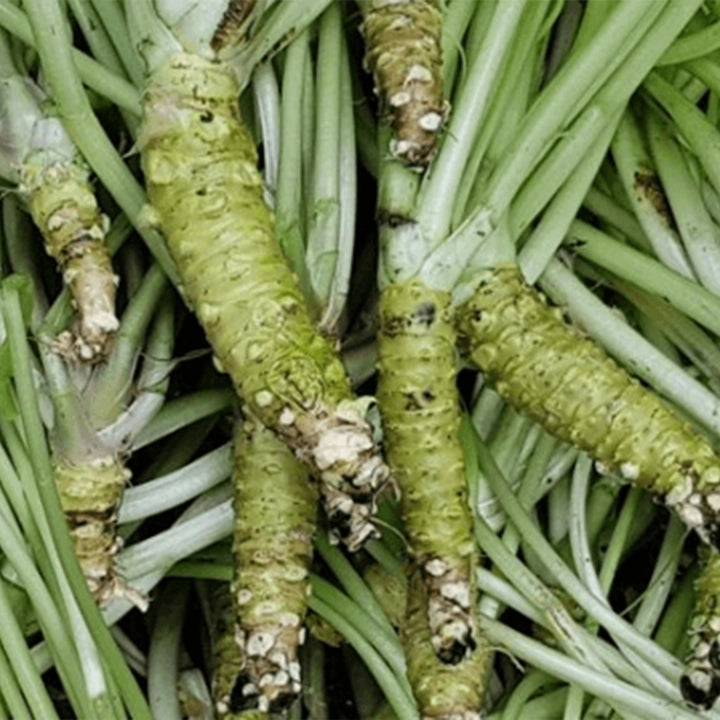
- Misho wasabi is the most common: root, stem and leaf are all green. It takes 12 months to grow.

Misho Wasabi
- Mazuma wasabi has a root, stem and leaves that take on darker colours tending towards purple. It reaches maturity after 2 years. It is rarer, and its price is set accordingly: a minimum of €200 per kg paid to the farmers.

Mazuma wasabi
Wasabi for sale on Nishikidori.com
For my part, I prefer misho wasabi for its perfect "kaori-amami-karami" balance: meaning "fragrance-sweetness-power (heat)". This is the one I shall therefore import. It will give you that distinctive warm rush, beads of sweat on the brow, and will perfectly clear your sinuses!
Each wasabi root will be wrapped in a special paper, slightly cottony and moistened with a mister. The ideal storage temperature will be between +2 °C and +8 °C.
Visit Nishikidori.com now or contact us on +33 (0)2 40 83 33 99.
You will also find all our wasabi-based products!
Wasabi in tubes all year round
This is real wasabi and not horseradish like all the wasabi in tubes and powder on the market. I already sell a wasabi paste whose genuine wasabi content is 37%, which is unique on the market. Beware of counterfeits.
The true wasabi root, known as hon'wasabi, is particularly rich in isothiocyanates and sinigrin. It is these isothiocyanates that produce the fleeting sensation of intense "mustardy" heat. However, it is in no way mustard and is therefore not an allergen.
My wasabi tasting tips
Before grating it, it is essential to trim the dark outer skin (thin skin). After each use and before putting it back in the refrigerator, cut a thin slice from the grated end (1 to 2 mm). This will ensure better preservation.
Wasabi is widely used when tasting sushi and sashimi. For my part, however, I find its ideal use is as an accompaniment to red meat or fairly fatty pork.
Try it, as a tasting too, with your meats or composed salads, mixed with citrus juices (orange, mandarin, lemon, lime). It is simply fresh and delicious. It will pair perfectly with goat's cheese or sheep's cheese, tommes, saint-nectaire…
Use it to further flavour your mayonnaises, crème fraîche, vinaigrettes, butter, chocolate, pralinés…
Only one problem: you become addicted very quickly.


