








Matsue, the prefectural capital of Shimane, owed its reputation to its wakame fishermen — the most renowned in Japan — harvested by wakame fishing cooperatives and independent fishermen. Five decades ago, Matsue had more than 150 active professionals.
In 2016, there were only a handful of them left, with an average age of 65. They owe their survival to the proximity of the mountains and a few cultivable plots of land that provide them with a meagre subsistence income throughout the year. The sea has become less profitable and wild wakame increasingly rare. They have developed wakame cultivation close to the coastline in order to make the activity less arduous, but this is not enough to keep younger generations in the trade.
Discovering the wakame harvest
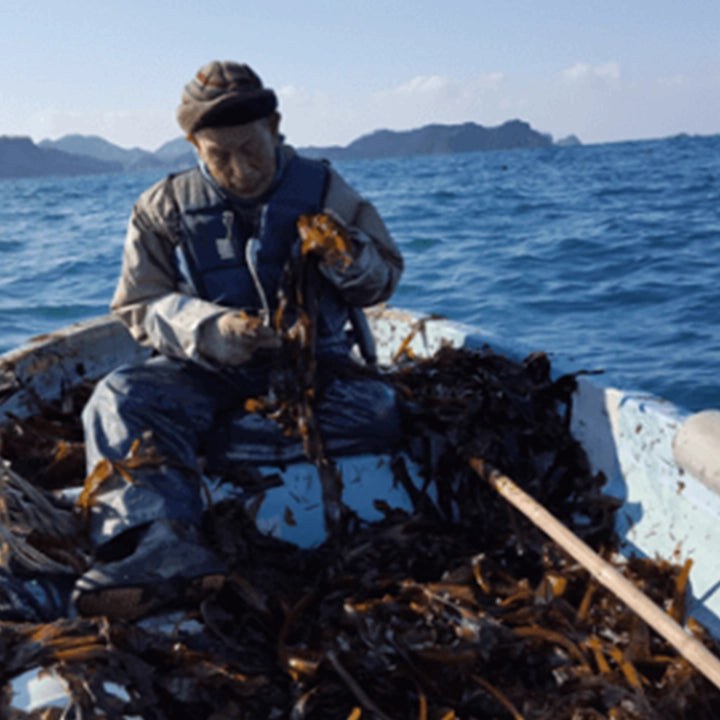
I followed one of them out to sea — a 90-year-old man — in his daily labour.

Shortly before we met, he had been hospitalised following a severe bout of flu. As soon as he had recovered some strength, he got back on his boat, headed out to sea, and regained all his physical capabilities.
I thus discovered cultivated wakame, spread across concessions of 9 rows of 300-metre ropes seeded with wakame. Each rope is spaced 20 metres apart, submerged — depending on the location — between 1 m and 1.50 m deep, and up to several metres for those situated close to the shore. The ropes are seeded in November and begin to be harvested in spring. They yield 200 kg per day over 2 months. The harvest begins at the end of February and ends at the end of April.

Tasting the wakame
Tasting seaweed freshly pulled from the sea is a moment of immense pleasure: the sound of the waves and the swell, the sea spray caressing your face, and the briny, oyster-like flavours as you bite into the root of a freshly harvested wakame.
I am in admiration of the work of this artisan fisherman, his daily dedication, and his passion for harvesting the finest produce for the pleasure of gourmets.
What will happen tomorrow when these craftsmen of yesterday and today are gone? What other junk food will succeed the delight of authentic, wholesome products?
I feel like a witness to an era I would not wish to see gone.
I therefore continue to defend and promote the work of these people who, like a vocation, devote their entire lives to the pleasure of others and to sharing enduring values.


