







In short: for perfectly cooked Japanese rice, rinse 500 g of rice until the water runs clearer, leave it to drain for 15 minutes, then soak it for 30 minutes in 550 ml of fresh water. Cook covered over a low heat for 15 minutes, then leave to rest for 15 minutes before lifting the lid. For sushi rice, reduce the water to 500 ml and season the rice while it is still warm.
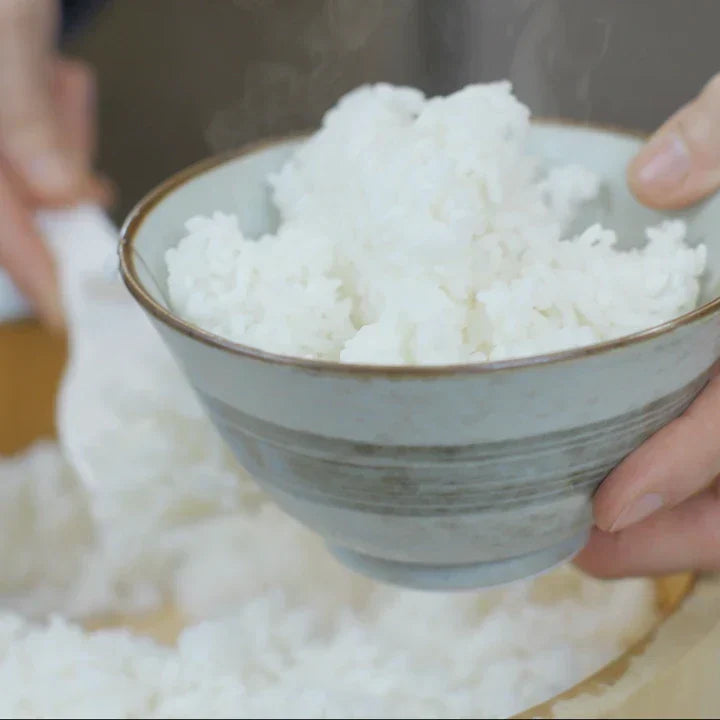
You can recognise good Japanese rice by its whole, glossy, slightly sticky grains, which hold together between chopsticks without turning mushy. In Japan, rice is not boiled in a large volume of water and then drained: it is cooked by absorption, in exactly as much water as it can take up.
So the key steps come before you turn on the heat: rinsing, resting and measuring the right amount of water. Here is our method, with quantities according to the number of diners and the seasoning for sushi rice.
Which rice should you choose for this recipe?
This method is designed for short-grain japonica rice grown in Japan. This type of rice contains more amylopectin than long-grain varieties, giving it a soft, slightly sticky texture. Kyodori Koshihikari rice, grown on terraces in Joetsu, Niigata Prefecture, is our go-to for both plain rice and sushi. The lighter Nanatsuboshi from Hokkaido keeps its grains nicely separate once seasoned with vinegar.
Long-grain rice or short-grain pudding rice will not give the same result: the former stays dry, while the latter becomes mushy. The method below works for all our Japanese rice varieties.

The right amounts of water
Our rule of thumb is 110 ml of water for every 100 g of rice. If the rice will be seasoned with vinegar for sushi, reduce this to 100 ml per 100 g, as the seasoning adds liquid too. The table below gives the full quantities, including water and seasoning.
| Raw rice | Water (plain rice) | Water (sushi rice) | Rice vinegar | Sugar | Salt | Servings |
|---|---|---|---|---|---|---|
| 250 g | 275 ml | 250 ml | 40 ml | 18 g | 5 g | 2 |
| 500 g | 550 ml | 500 ml | 75 ml | 35 g | 10 g | 4 |
| 750 g | 825 ml | 750 ml | 110 ml | 50 g | 15 g | 6 |
Two adjustments are worth knowing. Rice from a new harvest has a higher moisture content and needs a little less water, around 10 ml less per 100 g. Conversely, rice stored for several months needs slightly more. If you use a rice cooker, simply follow the markings inside the bowl for the number of measures of rice you have added.
Step-by-step cooking method
Ingredients for 4 people
- 500 g Japanese rice
- 550 ml fresh water
Preparation
- Place the rice in a bowl of cold water and rinse it by swirling it around 10 times with your hand. The water will turn milky. Drain the water and repeat the rinse twice.
- Leave the rice to drain for 15 minutes.
- Put the rice in your rice cooker or saucepan, then cover it with 550 ml fresh water. Leave to soak for 30 minutes.
- In a rice cooker: press ‘start’ on the normal rice setting. Cooking can take 37 to 60 minutes, depending on the model.
- In a saucepan: start with the pan cold and heat over a medium heat, uncovered. As soon as the water begins to simmer, stir quickly 3 or 4 times to prevent clumps forming. Cover and cook over a low heat for 15 minutes.
- Remove from the heat and stir gently. Cover with a clean tea towel, put the lid back on and leave to rest for 15 minutes before serving.
Tip: a heavy-based saucepan or cast-iron casserole distributes heat more evenly and stops the rice sticking. For consistent results without having to watch over it, a rice cooker is a staple in Japanese homes.
Why rinse and soak the rice?
Rinsing removes the loose starch left on the grains after polishing. Without rinsing, this starch turns gluey during cooking and the rice becomes mushy. Rinse until the water is only slightly cloudy: it does not need to be perfectly clear.
Soaking allows water to penetrate right to the centre of each grain. Over those 30 minutes, the rice turns slightly white and becomes opaque. This ensures even cooking: without soaking, the outside of the grain cooks while the centre remains firm.
Sushi rice: the seasoning
Sushi rice, or shari, is plain rice cooked with slightly less water and seasoned while still hot. Prepare the seasoning while the rice cooks: gently warm the rice vinegar with the sugar and salt until completely dissolved, without letting it boil, then leave it to cool.
- Spread the hot rice in a large, wide, shallow dish, ideally made of wood.
- Pour the seasoning in a thin stream over a spatula to distribute it across the entire surface.
- Mix by cutting through the rice with the spatula, without crushing it, while fanning it so it cools quickly and becomes glossy.
- Cover with a damp cloth until ready to use, keeping it at room temperature and never in the fridge.
No time to measure everything out? Sushi vinegar, already sweetened and salted, replaces all three ingredients: use 90 ml for 500 g of uncooked rice.

What can you make with your Japanese rice?
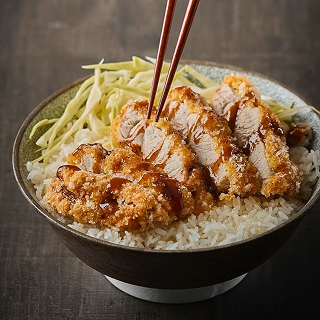
Plain rice accompanies most Japanese dishes, perhaps with a little furikake or some pickles. Shaped into balls, it becomes a snack to take with you: follow our onigiri recipe. Seasoned with vinegar, it forms the base for maki, nigiri and chirashi salad. Served in a bowl topped with glazed meat or fish, it becomes donburi, an everyday complete meal in Japan.
Common mistakes to avoid
- Skipping the rinse: starch on the surface makes the rice mushy.
- Skipping the soak: the centre of the grain stays hard while the outside cooks.
- Keeping it boiling throughout: reducing the heat is crucial to avoid breaking the rice grains.
- Lifting the lid: the steam finishes cooking the rice while it rests.
- Seasoning cold rice: the vinegar can no longer soak in, and the rice becomes sticky.
Storing and reheating rice
Cooked rice keeps for 24 hours in an airtight container in the fridge. To reheat it, add a spoonful of water and warm it covered, either by steaming or in the microwave. To keep it longer, freeze it while still warm, in flattened portions wrapped in cling film: it regains its texture in a few minutes. Sushi rice, however, should be eaten the same day.
Frequently asked questions
How do Japanese people cook rice?
By absorption: the rice is rinsed, soaked and then cooked in just enough water, usually in a rice cooker. It is never drained after cooking.
How much water do you need for 500 g Japanese rice?
550 ml for plain rice, 500 ml for sushi rice.
How do you make good sushi rice?
Cook the rice with a little less water, then mix it while still hot with the rice vinegar, sugar and salt seasoning, fanning it as you go.
Should you salt the water when cooking Japanese rice?
No. Japanese rice is cooked in plain water; seasoning is added afterwards, either to make sushi rice or in the dishes served alongside it.
How long does cooked rice keep?
24 hours in an airtight container in the fridge, or one month in the freezer. Sushi rice should be eaten the same day.
Enjoy your meal
Once you have the method down, it never changes: rinse, soak, cook, leave to rest. All that remains is to choose what to serve with it.


