








What is the ikejime method?
Ikejime is a traditional Japanese technique consisting of killing the fish quickly in order to reduce stress and limit its suffering. When the fish struggles at the moment of death, blood spreads throughout the body and the flesh takes on a pinkish colour. The practice of ikejime (immediate death and exsanguination) keeps the flesh an appetising colour. This is especially visible on white-fleshed fish, such as this brill:
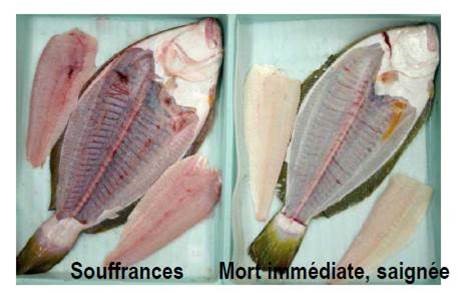
(Hokkaido Research Institute)
Generally, two incisions are made: the first at the point where the central bone meets the head, located at the level of the gills. Then, once ikejime has been performed, another incision is made at the base of the caudal fin (the tail) to draw out the blood.
The aim of ikejime is to maintain the quality of the fish. This technique should be performed on a live fish or a fish that has just died.
The opposite of ikejime is death by struggling, which causes suffering to the fish and a loss of flavour and colour.
How to ikejime a fish?
There are 2 ways to perform ikejime. The most common in Japan is performed on the right side of the fish, so as to present the fish without an incision on the fishmonger's counter, in the same order. The second is to pierce the skull of the fish between the two eyes. We will present the most common method, ikejime on the right side:
Step 1: at the point where the central bone meets the head, at the level of the gills, where the flesh is softer, pierce the skull of the fish with the spike until the brain is reached. Once reached, turn the tool to destroy the brain in order to end the fish's suffering.
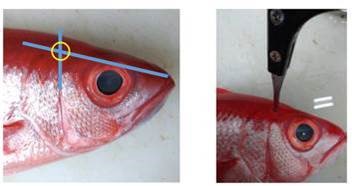
Step 2: withdraw the spike and insert it along the extension of the central bone in order to subsequently thread the needle through it.
Step 3: insert the needle through the spike, first bending the needle to make it easier to thread through the channel beneath the central bone. It must pass through the central bone and destroy the spinal cord. Please note that as the needle passes through the nervous system, the fish will move.
Step 4: push the needle in as far as possible using back-and-forth movements.
Step 5: once the needle has been removed, make an incision at the base of the caudal fin (the tail) to allow the fish to bleed. Reinsert the needle and make back-and-forth movements. Cut the third gill so that the fish is drained of its blood, and allow the blood to drain away. Submerge the fish and move it in water to remove all traces of blood.
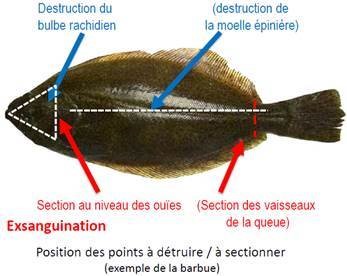
(Hokkaido Research Institute)
Our storage advice:
It is important to cool the fish quickly to its core. If you use only seawater and ice, the fish will be too cold and will freeze. If you use fresh water and ice, it will take a long time to cool the fish. Ice alone is the slowest method.
The "half seawater + ice" method is used by fishermen to cool the fish immediately after closing. Half seawater and half fresh water are placed in a cool box. Fill a cool box with half seawater, half fresh water and preferably a bag of ice. Place the fish in the box and allow it to cool. If the seawater concentration is too high or the cooling time too long, the fish may freeze. Thus, a 1:1 ratio of seawater to fresh water for approximately 30 minutes to 1 hour should suffice.
Where to learn ikejime?
The best school is of course in Japan. Nevertheless, our videos and texts will largely enable you to practise the art of ikejime.
Where to buy a tool for ikejime a fish?
Nishikidôri offers various ikejime kits. Our Paris shop and our online store welcome you.
What are the benefits of ikejime?
This increasingly practised technique ensures an extremely quick death with minimal suffering. This absence of suffering reduces stress and therefore guarantees better quality fish. It also allows for longer preservation.


