







Of rural origin, I have always been drawn to the Japanese countryside. Oita Prefecture, located to the east of the island of Kyushu, is renowned for its plains and forests.
What are shiitake?
The forests in question are teeming with small shiitake mushroom plantations. I am not talking about those low-grade products raised in vast cellars in China and frequently treated with formaldehyde (formalin), but the noble oak mushroom. And speaking of the "oak mushroom", you will understand the origin of this name as you walk through the forested hills and mountains of Oita.

Mycelium development
The ancestral cultivation of shiitake
There, cultivators keen to produce quality shiitake, in full respect of tradition, inoculate oak trunks with shiitake mycelium and leave them to emerge and evolve, to develop, in the heart of nature. The soil is rich in humus and the temperatures are cool.

Grows naturally in the undergrowth under the watchful eye of Mother Nature!
Every year in November, farmers fell Japanese oak trees aged 12 to 15 years. These are then left on the ground for 2 months. They are subsequently cut into 125 cm pieces and inoculated with shiitake mycelium. To do this, 20 holes are drilled into the trunk with a drill bit. Finally, the inoculated trunks are laid one on top of the other in a linear fashion, in a few rows, then covered with leaves and branches. They will remain abandoned like this for 2 long years, a period that is essential for the proper development of the mycelium.
The inoculated trunks, after 24 months, are stood upright in rows in damp, cool undergrowth rich in humus.
The shiitake, in full respect of nature, mother of patience, then develop.
The time comes to harvest the shiitake
The harvest is done by hand when the mushrooms have reached good maturity.
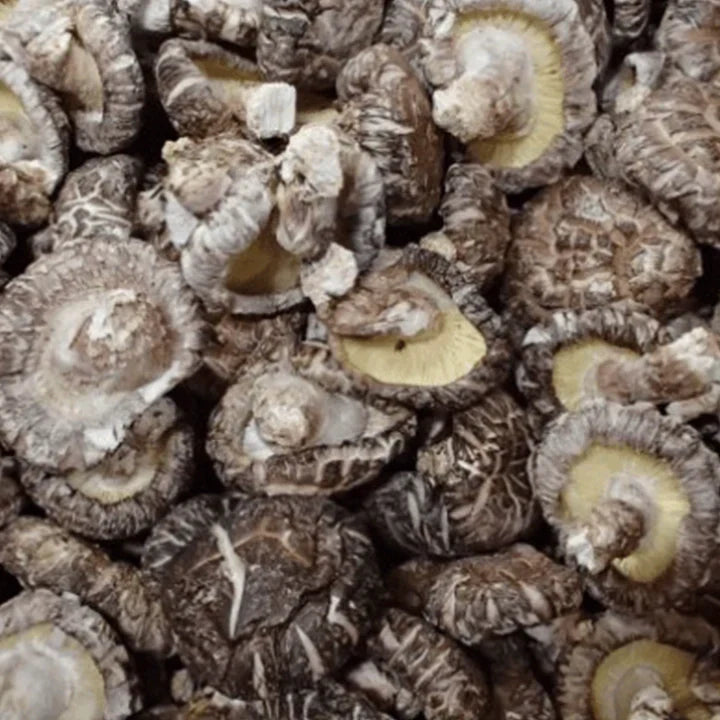
They are then mechanically dried and sorted into 3 grades:
- Koushin: these are the finest. They rehydrate quickly and are perfectly suited for making thin slices. I recommend them cooked with rice, in stuffings, or for making gourmet bites.
- Kouko: these are the majority of the harvested products — larger and thicker. The Japanese love them, once rehydrated, steamed, pan-fried, in a gratin…
- Donko: these are my favourites. They are thick, fleshy, plump and pleasantly juicy, with a satisfying chew. Their aroma is subtle and woody. I love them cooked with soy sauce and mirin, or grilled, or in a broth fondue.

Mother Nature does things well
Oita accounts for more than a third of Japan's production of this mushroom. It is a quality delicacy with excellent health benefits. The cultivation is wholesome and natural, without the slightest use of any chemical products. Only nature decides!
Find our shiitake mushrooms at Nishikidori!


