








A Japanese sharpening stone restores a knife’s original edge. In Japan, sharpening is an integral part of cooking, not a task reserved for specialists. Japanese sharpening stones use water: soaked before use, they release a fine abrasive slurry as you work, cutting quickly and leaving a remarkably clean edge.
Choosing the best Japanese sharpening stone comes down to understanding one thing: grit, which determines whether the stone repairs, sharpens or polishes. This guide explains grits, technique, stone care and how double-sided stones make it all simpler.
The Japanese water stone: why it sets the standard
A Japanese water stone differs from mechanical sharpeners and honing steels in one essential respect: it removes material precisely and evenly, without heating the steel or rounding the edge. The slurry that forms on the surface as you work acts as a liquid abrasive, giving Japanese stones their cutting speed and finish.
There are two main types: synthetic stones, with a calibrated, consistent grit, which are now the standard choice for routine maintenance; and natural stones, quarried in Japan and prized by sharpeners for their distinctive finishes. For beginners and for regular professional use alike, a synthetic stone is the practical choice: predictable, consistent and economical.
It is also the method that respects hard Japanese steels sharpened at a narrow angle: a Japanese knife maintained on a stone keeps an edge that no pull-through sharpener can match. The technique takes just a few sessions to learn and permanently changes how you use your knives.
Understanding grits: coarse sharpening, sharpening and finishing
Grit, indicated by a number, measures how fine the abrasive is. Three categories cover every need:
| Grit category | Approximate | Role |
|---|---|---|
| Coarse grit | Approximately 200 to 400 | Coarse sharpening: repair a damaged edge or remove a chip |
| Medium grit | Approximately 800 to 1,500 | Sharpening: routine edge maintenance |
| Fine grit | 3,000 and above | Finishing: polish the edge for a lasting, razor-sharp result |
Medium grit handles routine sharpening of a kitchen knife; fine grit provides the finish that helps the edge last; coarse grit is only needed for occasional repairs, when the edge has hit a bone, a stone in fruit or the bottom of the sink. There is no need to collect stones: two well-chosen grit levels are enough for home or professional use.
The double-sided stone: the simplest solution
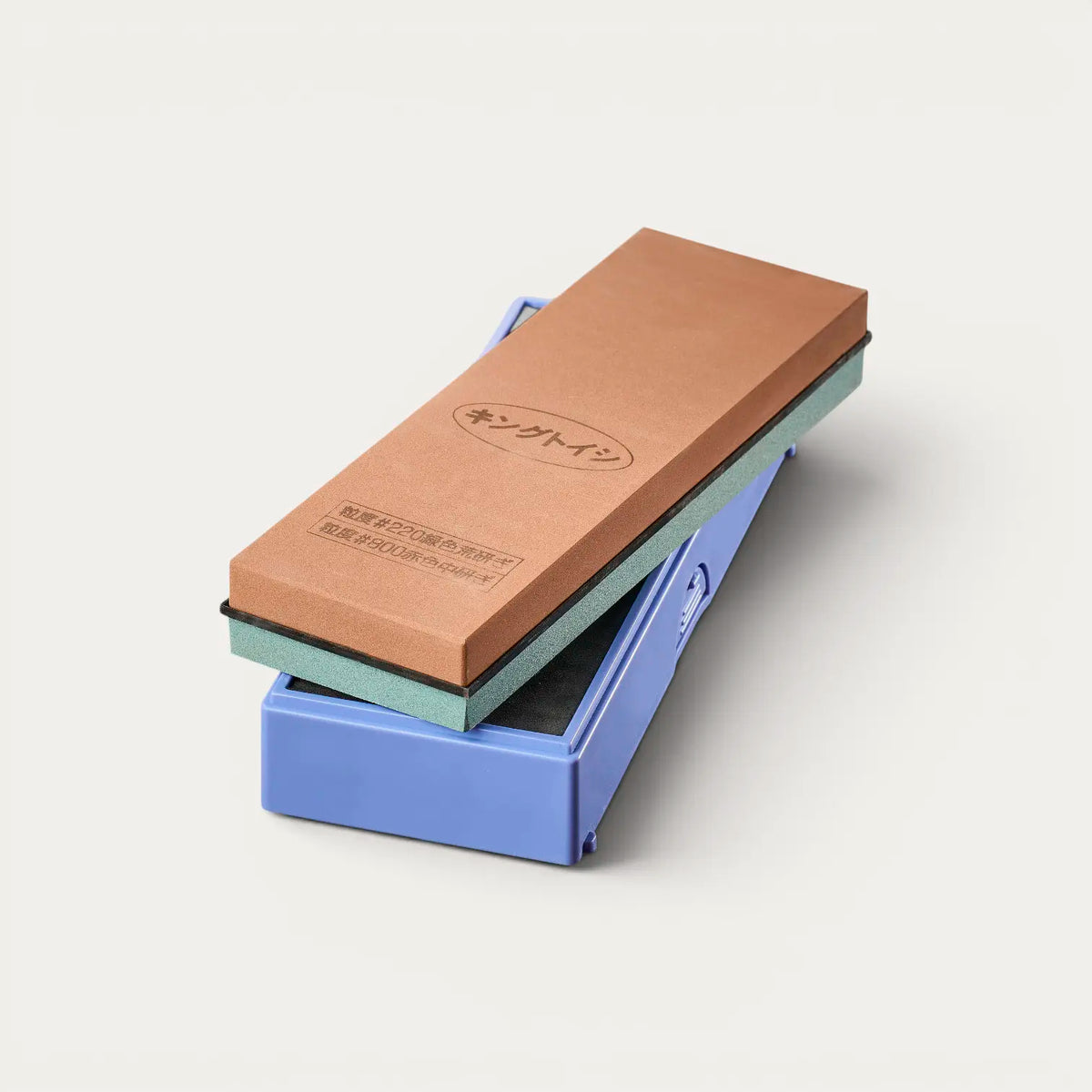
That is the idea behind combination stones, which bring two grits together on one stone. Our selection centres on two complementary options: the double-sided water sharpening stone for coarse sharpening, which covers repairs and basic sharpening, and the double-sided water sharpening stone for finishing, which refines and then polishes the edge.
Together, they cover the entire life cycle of an edge, from a dull blade to a razor-sharp finish, without extra purchases or difficult choices.
The technique: angle, movement, consistency
Sharpening on a stone rests on three consistent principles:
- The angle: about 15 degrees between blade and stone for a Japanese knife, roughly equivalent to two coins slipped beneath the spine of the blade.
- The movement: make even strokes from heel to tip, covering the full length of the edge on each side of the blade.
- Consistency: ten minutes of medium-grit maintenance each month is better than one long corrective session each year.
At the end of sharpening, a slight burr forms along the edge. A few gentle strokes on a fine-grit stone remove it and leave a finished edge.
Always work on a stable stone, set on its base or a damp tea towel. Rest your fingers lightly on the flat of the blade, never on the edge. Pressure will not speed things up: a consistent angle creates a sharp edge, not force.
Caring for your sharpening stone
Soak a water stone before use until it stops releasing bubbles, then rinse it and leave it to air-dry afterwards. Over time, the centre of the surface becomes hollowed out. Flattening it regularly with a flattening stone or a flat abrasive restores the even surface needed for precise sharpening.
A well-maintained stone works for years without losing its qualities. Store it dry and protect it from frost. Reserve it for knives: scissors and garden tools deserve their own stone, so your kitchen stone stays flat.
Traditional sharpening and keeping the edge sharp
Japanese sharpening is a craft in its own right, as shown by kasumi togi, a traditional sharpening method. Its edge work and polishing give blades their characteristic misty contrast and exceptional cutting ability. You need not reach that level of mastery to follow its principle: build an edge in stages, moving from the coarsest grit to the finest.
One final reminder about keeping an edge sharp: the stone restores it; the board preserves it. A chopping board suited to Japanese knives lets you leave longer between sharpening sessions. The two tools work together.
Frequently asked questions
What is the best Japanese sharpening stone?
The one with the grit that suits your needs: medium for routine sharpening, fine for finishing, coarse for repairs. A pair of double-sided stones covers the full cycle.
Should you soak the stone before use?
Yes, for conventional water stones: submerge the stone until the bubbles stop, usually after a few minutes. The wet stone develops the abrasive slurry that gives Japanese sharpening its quality.
Which grit should you use for a kitchen knife?
Medium grit (approximately 800 to 1,500) is central to maintenance: it restores a clean edge. Follow it with fine grit (3,000 and above) for a durable, truly keen edge.
How often should you sharpen your knives?
For daily use, a short session on a medium-grit stone every few weeks is enough, followed by finishing. The best guide is how the knife cuts: when a tomato starts to resist, it is time for the stone.
Water stone or honing steel?
The two complement each other: a honing steel realigns the edge between sharpening sessions, while a stone actually restores it by removing material. Only the stone brings the bite back to a dull blade.
How can you tell if a knife is properly sharpened?
The paper test: a sheet held in the air should cut cleanly, without snagging. A well-finished edge cuts silently, without pressure, from heel to tip.
Can you sharpen every knife on a Japanese stone?
Yes, Japanese and European blades alike: only the angle changes slightly, with a wider angle for Western knives. Serrated blades, such as bread and tomato knives, are the exception: their teeth need a dedicated tool.
In summary
A double-sided stone, with medium grit for sharpening and fine grit for finishing, covers the essentials. A consistent angle matters more than the number of stones.


