







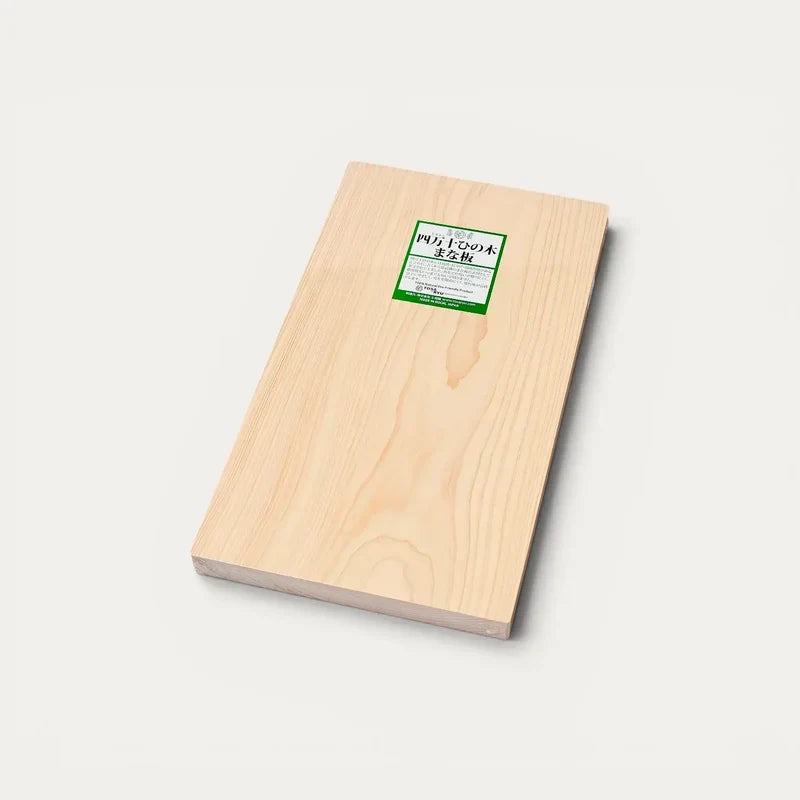

After the knife, the Japanese chopping board is a cook’s second tool, and the one most responsible for how long the knife’s edge lasts. Three types dominate the market today: hinoki wood, the cypress used for traditional Japanese chopping boards; titanium, a recent social-media phenomenon; and the professional specialist surfaces popularised by Hasegawa.
Each has its own strengths, and not all suit Japanese knives. This guide compares the three materials, criterion by criterion, and helps you choose the right board for your knife, how you use it and the care you’re prepared to give it.
Hinoki: the wood of Japanese kitchens
Hinoki is a Japanese cypress with pale, soft and delicately scented wood, harvested from managed forests. The boards in our selection use wood from Kōchi Prefecture. Its softness is precisely its strength: the blade sinks slightly into the surface instead of striking against it, protecting knife edges, particularly those of hard, thin Japanese blades.
In use, a professional hinoki wood chopping board also offers the quiet, tactile comfort cooks so often describe: cutting feels cushioned, precise and quiet. That feel explains why sushi chefs and traditional kitchens remain loyal to hinoki: long sessions of precise cutting with a thin-bladed knife cause neither fatigue nor vibration.
The wood also has valuable natural resistance to moisture, thanks to the cypress’s essential oils, provided it is properly cared for.
The titanium chopping board: is the trend worth it?
Titanium boards have taken social media by storm, with genuine advantages: the material resists corrosion, is non-porous, very hygienic, lightweight and virtually impossible to wear out, and retains neither odours nor stains. For quick, occasional cutting tasks (fruit, bread, cheese) or outdoor use, these qualities are undeniable.
There’s also a sensory factor that videos overlook: cutting on metal feels hard and sounds loud, with no cushioning at all. During a long session of food preparation, the difference in comfort compared with wood is obvious: your wrist feels it before your knife does.
The downside is just as real: titanium is a hard metal, and every strike of the blade against a hard surface wears down its edge. For a finely sharpened Japanese knife, a metal board is the worst everyday partner: the edge dulls faster and needs sharpening more often. The honest verdict: titanium can complement your equipment, but it shouldn’t be your main chopping board for Japanese knives.
Hasegawa: the specialist surface for professionals
Between wood and wholly synthetic boards, Hasegawa boards have won over professional Japanese kitchens with their hybrid construction: a wood core for lightness and cushioning, covered with a specialist surface designed for hygiene and intensive cutting. The brand supplies both large kitchen teams and sushi restaurants, where boards see several hours of use a day without showing marks.
The result combines the best of both worlds: a surface that’s gentle on the blade edge, easy to maintain and hygienic enough for professional demands. The Hasegawa FSR professional chopping board and Hasegawa FPE board exemplify this benchmark range, designed for intensive service as well as demanding home kitchens.
Material comparison
| Criterion | Hinoki (wood) | Titanium | Specialist surface (Hasegawa) |
|---|---|---|---|
| Gentleness on the knife edge | Excellent | Poor; wears down the edge | Very good |
| Hygiene and care | Good with regular care | Excellent, very straightforward | Excellent, designed for professional kitchens |
| Weight and ease of handling | Lightweight | Very lightweight | Lightweight (wood core) |
| Cutting comfort | Cushioned, quiet | Hard, noisy | Cushioning |
| Recommended use | Main board for use with Japanese knives | Occasional use, outdoors, foods that don’t need fine cutting | Main board, intensive use |
The principle is simple: the finer and harder your knife, the softer the chopping surface needs to be. A Western chef’s knife, with softer steel and a wider edge angle, is more forgiving; a finely sharpened Japanese yanagiba or santoku is not. That’s why hinoki and specialist surfaces dominate Japanese kitchens, while titanium remains an occasional extra.
Choosing well: size, stability and use
Beyond the material, three practical criteria will help you make the right choice:
- Size: a board around 45 cm long provides comfortable working space for cutting with a Japanese knife; widths of 24 to 27 cm suit most domestic and professional uses.
- Stability: a board placed on a damp tea towel won’t slip, a basic safety measure whatever the material.
- A good match for your knives: a fine Japanese knife deserves a surface that protects it; what you save on the board, you’ll spend in sharpening sessions.
Caring for your Japanese chopping board
Rinse a hinoki board with cold water immediately after use, leave it upright to air-dry and never put it in the dishwasher. For cuts that leave marks, a chopping board scraper refreshes the surface without harsh detergent. Hasegawa specialist surfaces can withstand more intensive cleaning in line with professional kitchen protocols.
The final link in caring for an edge: the board protects it, while the stone restores it. Regular use of a whetstone completes your routine and closes the virtuous circle of knife, board and stone.
Frequently asked questions
What’s the best material for Japanese knives?
Hinoki wood: its soft surface protects the edges of hard, thin blades. Specialist surfaces such as Hasegawa come a close second, with a hygiene advantage under intensive use.
Does titanium damage knives?
It wears down the edge faster than a soft surface: every strike against hard metal dulls the blade. It’s fine as an occasional extra board, but a poor choice as the main chopping board for Japanese knives.
Why is hinoki so widely used in Japan?
For its combination of softness, lightness and natural resistance to moisture, plus a subtle cypress scent. It has long been used in Japanese kitchens and baths.
How do you clean a hinoki board?
Rinse with cold water immediately after use and leave upright to air-dry; never put it in the dishwasher or soak it for a long time. A dedicated scraper refreshes the surface more deeply.
What is a Hasegawa board?
A professional Japanese board with a wood core and specialist surface: gentle on blade edges, lightweight and designed to meet the hygiene demands of busy kitchens. A favourite among chefs.
What size board should you choose?
Around 45 cm long gives you room to work comfortably with a Japanese knife, with a width of 24 to 27 cm depending on your worktop. A board that’s too small restricts your movements and becomes unsafe.
Wood or a specialist surface for raw foods?
Both are suitable for raw foods with a proper routine: clean immediately, dry completely and ideally use separate boards for different types of food. In intensive professional use, a specialist surface makes disinfection easier.
In summary
Hinoki for comfort and protecting the knife edge; a Hasegawa specialist surface for hygiene and intensive use. Titanium, meanwhile, damages the edge: avoid it with Japanese blades.


